
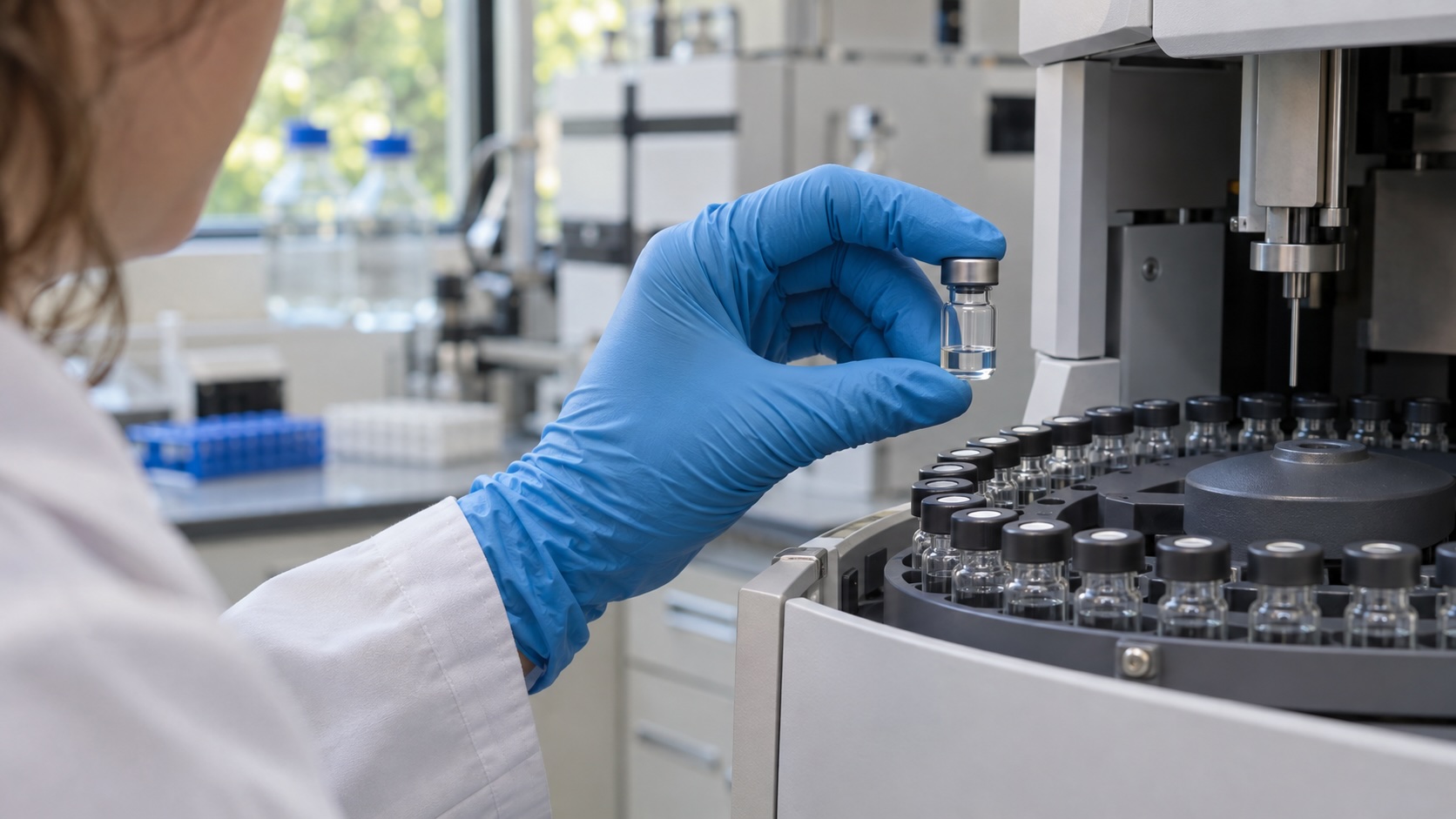

Before a cannabis lab can measure THC in a sample, it needs a benchmark. Labs buy calibration vials from companies that make them specifically for testing. For example, a vial might be labeled “1 milligram of THC per milliliter.” The lab uses that number to calibrate its instrument. If the label number is wrong, it can throw off the potency results for the samples the lab tests.
At the Cannabis Quality Conference, Nandu Sarma of United States Pharmacopeia (USP) presented a study that put those vials to the test.
How a Vial Can Affect a Potency Result
A lab can dilute the liquid from a calibration vial to make several known levels of THC. It measures each one to see how the instrument responds, then uses those readings to calculate how much THC is in a cannabis sample.
Suppose a vial labeled as containing 1 milligram of THC per milliliter actually contains 0.8 milligrams per milliliter. If the lab treats the weaker reading as the signal for 1 milligram per milliliter, it can overstate how much THC is in the sample.
Sarma used a USP test for CBD as a pharmaceutical ingredient to show what’s at stake. When a batch is close to the cutoff, an error in calibration can be enough to make it pass when it should fail, or fail when it should pass.
What the Five Labs Found
The American Council of Independent Laboratories coordinated the study, which included vials from five suppliers. One of those suppliers was Restek, a company that sells calibration vials to testing labs. All five labs used Restek vials as a common benchmark to set up their instruments. They then used their own testing methods to see how closely the vials in the study matched the amounts listed by their suppliers.
For delta-9 THC, CBD, and CBDA, the measured amounts were within 5% of what the suppliers listed across the batches tested. THCA-A showed more variation. Seven of 16 results fell outside the 5% range, and the two largest differences came from the same supplier.
The study was designed to examine variability across the vials included in the comparison. Sarma said the manuscript was under peer review at the time of his presentation.
Don’t Take Their Word for It
When a new batch of calibration vials arrives, the lab can use the instrument it has already calibrated to measure the THC in one of the new vials. If the lab’s measurement matches what’s on the label, it can use the new batch.
If the difference is larger than the lab allows, it can set the new vials aside and double-check its measurements. If the discrepancy persists, Sarma recommended contacting the company that made the vials so it can investigate.
Labs should spell out how they check each new batch of calibration vials before using it to test customer samples. The procedure should say how close the lab’s measurement needs to be to the amount on the label and what to do if it falls outside that range. Checking the vials up front can keep a single discrepancy from affecting every potency result measured using that calibration.

