
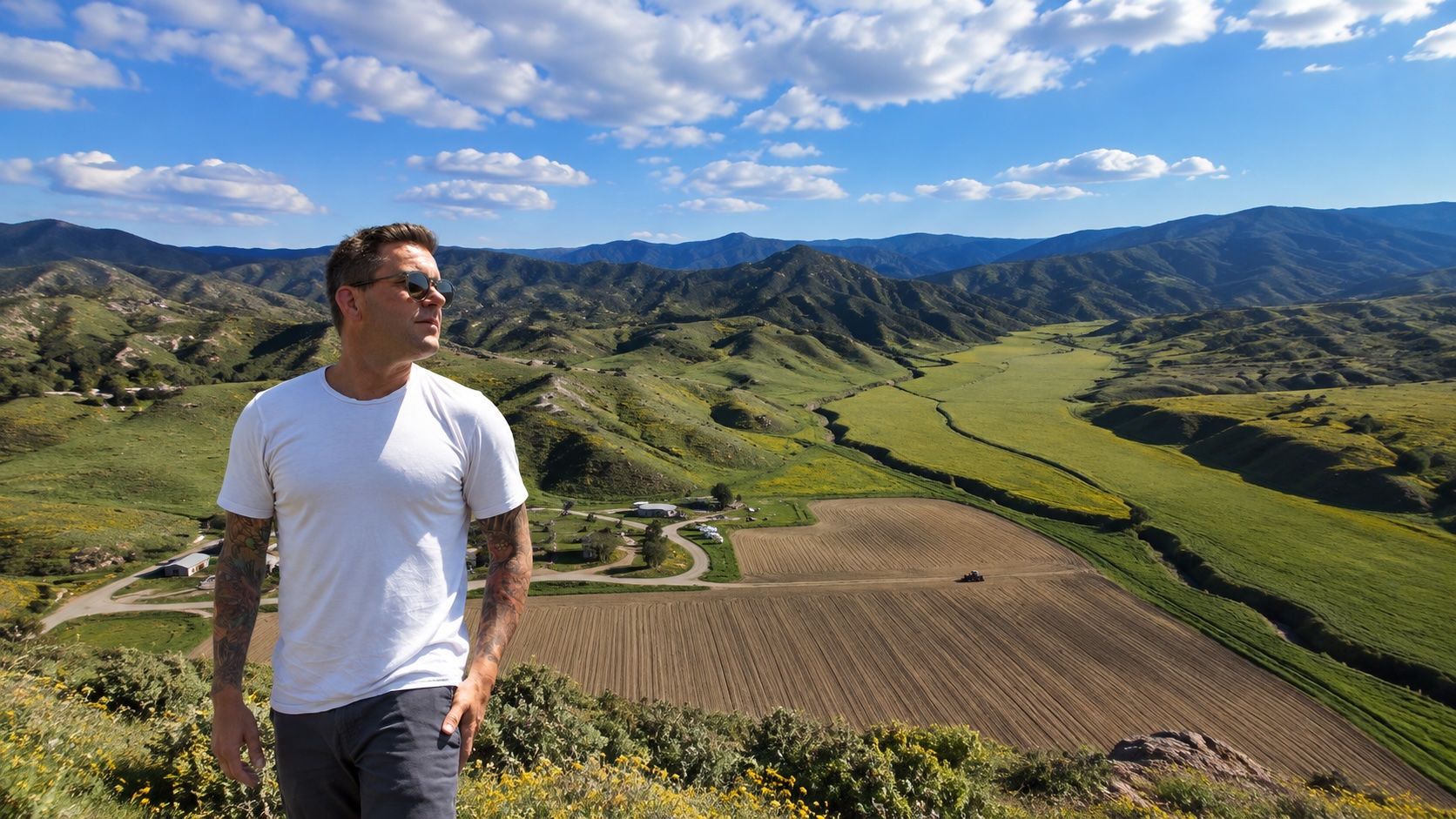

Micah Anderson has spent nearly three decades in California cannabis, beginning as a cultivator in Mendocino County and eventually becoming CEO of publicly traded LEEF Brands.
Today, the company is focused on building a large-scale cannabis supply chain that combines outdoor cultivation with concentrate manufacturing. Its strategy centers on controlling production costs, securing clean biomass, and preparing for a future in which cannabis products may move across state and international borders.
LEEF has invested in Salisbury Canyon Ranch in Santa Barbara County, where Anderson believes the climate, cultivation economics, and location, which helps minimize pesticide drift, give the company an advantage. Meanwhile, LEEF has paused its expansion in New York to give that market more time to mature.
In this interview with Cannabis Industry Journal, Anderson discusses the economics of producing concentrates, why LEEF brought cultivation in-house, lessons learned in New York, and how the company is preparing for potential changes in federal cannabis policy.
Why LEEF Brought Cultivation In-House
CIJ: LEEF started as a concentrate company. What led you to invest in such a large cultivation operation?
Anderson: We found that the success of our business came from pairing low-cost, high-quality outdoor cultivation with a larger concentrate business.
When we didn’t own the cultivation site, it was hard to predict our business, both from a margin standpoint and a supply chain standpoint. That’s why we brought it in-house.
We’re really a supply chain company. Right now, we supply concentrates. Could we eventually move into flower? Absolutely. We’ve thought about turning some of our acreage into flower production, but we haven’t done that yet.
We built the entire farm around supplying our concentrate business.
CIJ: How much of an advantage does outdoor cultivation give you in terms of production costs?
Anderson: Our cost to produce a pound is under $10 at this point.
With indoor cultivation, if you’re treating it as biomass for extraction, the economics don’t work. You’re looking at $200 to $300 per pound, sometimes higher. You can’t make money at those price points. You have to turn that into a flower product.
We treat cultivation like agriculture. We row-crop, farm organically, and use seeds rather than clones.
We’re always trying to keep quality as high as possible while keeping our cost of goods as low as possible. We can’t control where the California market is on pricing, but we can control our production costs.
Building a Cleaner Cannabis Supply Chain
CIJ: You’ve been outspoken about pesticide contamination in cannabis. How did that influence where you established Salisbury Canyon Ranch?
Anderson: When we first started the company, I was really focused on pesticides and GMOs. Initially, I approached it from a moral standpoint. I felt the cannabis industry should adopt strict standards and promote them.
Over time, we realized California had a significant problem with pesticide drift. About 60% to 70% of the material we try to purchase in California fails for pesticides when concentrated.
We purchased one of the largest cultivation sites in California and built it from the ground up. We chose the location carefully to mitigate pesticide drift as much as possible.
So far, it’s worked.
I think this is one area where strict regulation actually protects the industry. I’m against a lot of the regulations and taxes we deal with, but pesticide standards are something we should support.
We encounter farms that have spent an entire year growing a crop, only to have it fail testing at the very end. It’s devastating for those cultivators, but I don’t think the answer is to weaken the standards.
CIJ: Are you seeing other cannabis businesses place more emphasis on securing cleaner supply chains?
Anderson: Absolutely. We’re getting inbound interest from brands involved in pesticide recalls or negative publicity that want to clean up their supply chains.
One of the challenges with outdoor cultivation is that many farms were established in counties that approved cannabis licenses early. Some of those locations weren’t necessarily selected with pesticide drift in mind.
California has a massive agricultural industry. If you’re cultivating in a wind corridor near conventional agriculture, contamination can become an ongoing problem.
You have to be selective about where you build these cultivation operations.
We’re also thinking about future markets. We want to build a supply chain large enough to support our business while meeting the standards required to export to Germany, South America, Brazil, or other markets.
Why LEEF Paused Its New York Expansion
CIJ: LEEF operated in New York for approximately a year and a half before pulling back. What happened?
Anderson: We entered New York because several of our California clients were expanding there and had difficulty finding the right ingredient suppliers.
We purchased a license and built a small extraction lab. We kept our capital expenditures low by moving equipment from our earlier California operations into New York.
Our plan was to buy biomass from local cultivators, extract it, and supply the brands we already worked with.
But we ran into the same issue we had previously solved in California. There wasn’t enough cultivation material available to support our business at the scale we needed.
The pricing also didn’t make sense.
Cultivators were getting $700 per pound for their material, and we needed to purchase biomass at something closer to $150 per pound to make the extraction economics work.
We started seeing pricing compression, and our supply chain wasn’t structured correctly because we didn’t integrate cultivation into the business.
Earlier this year, we received a significant investment, and the investors agreed that we should finish building our California operation before putting more capital into New York.
We still have our license and our lab in New York. We haven’t abandoned the market.
CIJ: Do you still see New York as an attractive cannabis market? What needs to improve?
Anderson: I think New York is going to be a huge market. The entire region has tremendous potential.
But you need retail. You need stores throughout the boroughs and municipalities so consumers can access products.
You also need cultivation and manufacturing capacity that matches the size of the market.
If you have too much product, prices collapse. If you don’t have enough, prices remain too high.
When prices are too high, you also create an incentive for products to enter illegally from other states, which puts additional pressure on the licensed market.
These are problems that occur in nearly every new cannabis market. It takes time for supply, demand, and pricing to work themselves out.
CIJ: You also compared cultivation performance between California and New York. What did you find?
Anderson: We partnered with a cultivator in New York and grew approximately one acre using our genetics and standard operating procedures.
At the same time, we grew the same genetics using the same procedures in California.
The New York crop dramatically underperformed in pounds per acre. We also had significantly lower extraction yields.
California has an agricultural advantage because of its climate. That’s why so much of the country’s agricultural production takes place here.
I think California will become very important in both domestic and international cannabis supply chains.
Preparing for Interstate and International Commerce
CIJ: If cannabis can eventually move across state lines, how could that change the economics for multistate operators?
Anderson: We’ve been having conversations with large multistate operators that have invested millions of dollars in cultivation and manufacturing infrastructure outside California.
Some of those companies have production costs that are several dollars per gram higher than ours.
What happens when California can ship products into those markets at a price they can’t come close to matching?
They may find it makes more economic sense to purchase ingredients from a California supplier than to continue operating expensive cultivation facilities in every state.
One company we spoke with operates in nearly every major market outside California. They could potentially pay us twice what we’re currently receiving for our products and still save money compared with producing them in-house.
There are other considerations, of course. Those facilities employ people, and jobs could be affected. I’m sympathetic to that.
But I believe businesses need to prepare for the possibility that interstate commerce changes how cannabis is produced and distributed.
State-by-state vertical integration largely stems from federal prohibition. If cannabis could move through the country like other agricultural products, companies wouldn’t necessarily build their infrastructure the way they have.
CIJ: Do you expect international exports or interstate commerce to open first?
Anderson: I think international commerce happens first.
We’re looking at different markets, but not every country allows concentrates, and some of the international markets are relatively small compared with the domestic U.S. market.
We’re doing a lot of work to prepare for international opportunities, but we’re not building a business that depends on those opportunities becoming available.
If they happen, that’s great. If they don’t, we still need a successful business in California.
I also think interstate commerce will take time. States are going to want to protect their existing industries, and there will likely be legal challenges.
We’re preparing for that possibility rather than assuming it will happen on a particular timeline.
Why LEEF Uses Seeds Instead of Clones
CIJ: At Salisbury Canyon Ranch, you’re growing from seed rather than clones. Why did you choose that approach?
Anderson: There are a couple of reasons, starting with cost.
We work with experienced breeders in California and primarily use feminized seeds. We run autoflowering varieties in the spring and full-term varieties in the fall.
Seeds can cost anywhere from 8 to 20 cents, sometimes 40 cents each. A clone might cost $2 to $4.
When you’re cultivating at our scale, that’s a significant difference.
The other issue is plant health. Hop latent viroid and Fusarium are concerns, and some of those problems can come from mother plants used repeatedly to produce clones.
We want to protect the soil at Salisbury Canyon Ranch. I consider that soil one of the most valuable assets on our balance sheet.
We do work with other cultivators who use clones successfully and have strong procedures to manage those risks. But for our operation, growing from seed makes sense right now.
It also helps that we’re primarily growing for extraction rather than finished flower.
Concentrates, Product Preservation and Market Demand
CIJ: Concentrates can present storage and preservation challenges. How do you manage those issues when supplying other manufacturers?
Anderson: It depends on the concentrate.
Cold-cure rosin and certain hydrocarbon fractions benefit from refrigeration, but many concentrate products don’t have those same requirements.
A lot of concentrate sales are in distillates, live resin, vape products, beverages, and tinctures.
I use the analogy of shipping grapes versus shipping wine.
Both come from the same agricultural product, but grapes have a much shorter shelf life. Wine can be stored and transported for much longer.
Flower has some of the same preservation challenges as grapes. Bulk concentrates generally have a longer shelf life, which can be an advantage for distribution and eventually exports.
Once a concentrate is formulated into a finished consumer product, the shelf life may change depending on that formulation.
Hemp, CBD and Future Business Opportunities
CIJ: LEEF originally developed a CBD consumer products business. Are you considering returning to that market?
Anderson: When we started the company, we were actually a consumer packaged goods business rather than an extraction company.
We created LEEF Organics around pesticide-free, non-GMO ingredients and a health and wellness philosophy.
We had products in Nordstrom, Marriott properties, and Four Seasons hotels. The line included CBD balms, tinctures, soaps, and other products.
When COVID hit, many of those retail locations shut down. At the same time, our California cannabis business was growing rapidly.
We made the decision to focus on cannabis extraction and completing our cultivation operation.
We still have the CBD brand, and we’re actively working on plans to relaunch LEEF Organics in the first or second quarter of 2027, potentially through both hemp and regulated cannabis channels.
That’s a business I’m personally passionate about.
CIJ: You also have permission to cultivate hemp at Salisbury Canyon Ranch. What would determine whether you move forward?
Anderson: We have a 100-acre hemp permit from Santa Barbara County.
We know how to cultivate hemp and extract cannabinoids. The question is whether it makes business sense under the regulations that eventually take effect.
There is so much uncertainty around the Farm Bill, rescheduling, and federal hemp policy that we’re being cautious about committing additional capital.
We’re working on GMP compliance and DEA licensing preparations, so we’re ready if opportunities develop.
But we don’t want to spend millions building something on regulations that could change.
Our business needs to succeed in California regardless of what happens federally.
CIJ: How do you think cannabis and hemp should be regulated in the future?
Anderson: I think we should stop treating them as two completely different industries.
If someone wants a CBD product, growers should be able to produce CBD-dominant genetics. If they want THC products, growers should be able to cultivate THC-dominant plants.
The important regulatory question should be the amount of THC in the finished product, rather than forcing farmers to destroy crops because plants exceed a particular THC threshold.
Once cannabis is extracted, it’s an ingredient. You can use different amounts of that ingredient depending on the product you’re manufacturing.
I think there could be a system where low-dose products are available through mainstream retail and higher-dose products are sold through more controlled channels.
The success of hemp beverages demonstrates the demand for cannabinoid products outside traditional dispensaries.
I’d like to see the industry become easier for consumers to access while maintaining important protections, particularly around pesticides and product safety.
Building a Business That Can Survive Today’s Market
CIJ: California remains an extremely difficult market. What gives you confidence in LEEF’s long-term strategy?
Anderson: California is brutal. It’s been an eight- or nine-year knife fight, and we’ve come close to going out of business more than once.
The regulations are too strict, and the taxes are too high.
But we’ve survived, and I feel confident about our position today.
California still has tremendous brand recognition, agricultural advantages, and decades of cannabis cultivation knowledge.
We’ve built our business around producing high-quality concentrates at a low cost and controlling our supply chain.
We’re preparing for interstate commerce, international exports, and changes in federal regulation, but we’re not depending on any of them.
We have a growth strategy for California and New York that we believe can work under the current market structure.
If those other opportunities open up, we’ll be ready.

