
Tag Archives: packaging

Soapbox

Labeling Cannabis Products is a Booming Market

By Marsha Frydrychowski
1 Comment

Legal marijuana sales are expected to hit $6.7 billion in 2016, with the market expected to climb to $21.8 billion in sales by 2020. As legal cannabis sales rise, cannabis labels are quickly becoming one of the fastest growing markets for label manufacturers.

An Industry Gaining Legitimacy

Since California first legalized medical cannabis in 1996, the cannabis industry has grown considerably. Voters in four states legalized recreational cannabis last week on Election Day, including California, which is currently the world’s 6th largest economy. Voters in another four states legalized medical cannabis as well, bringing the total to 28 states with some form of legalization measure.

The market is moving ahead and will not be limited to small businesses and dispensaries either. Already, more than 50 publicly traded companies have blitzed the market, including pharmaceuticals, medical growers and even major tech companies.

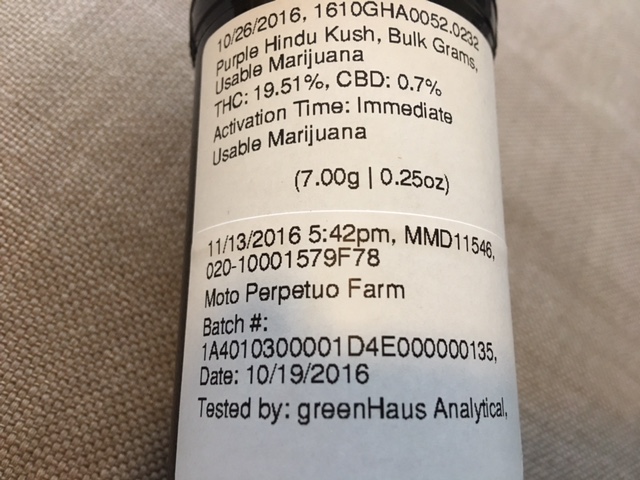
An example of a cannabis flower label in Oregon with all of the required information.

What’s more, public support for full cannabis legalization is at an all-time high 61 percent, according to a recent survey from the AP-NORC Center for Public Affairs Research. The market is here to stay.

Cannabis flower labels

Legal cannabis has primarily consisted of dispensaries selling cannabis flower or leaves (ready-to-smoke marijuana) in pouches or childproof containers. Regulations have essentially required two cannabis labels for the pouches: a branded label on the front and a regulatory label on the back. Many dispensaries also use pre-printed pouches.

Similar to the way alcohol labels must contain information for alcohol content, the informational labels that sit on the backs of pouches are legally required to provide certain accurate information, including:

The universal symbol required on all cannabis products in Colorado
  • THC %
  • CBD %
  • Net weight in grams
  • Lab name and test number confirmation
  • Batch number
  • Date tested
  • Strain name
  • Warning Label

And cannabis flower labels are just the beginning. Many smoke-free product categories are emerging with similar labeling requirements. These often allow for increased branding opportunities that will afford better profit margins for label suppliers. Some of the many products in this young category include:

  • Edibles — such as dark chocolates, baked goods, snack crackers and teas infused with cannabis.
  • Topicals — such as pain-relieving lotions and creams.
  • Tinctures — cannabis-infused oils that are applied in drops to the tongue.

Bottom line: For label and packaging suppliers, cannabis represents one of the fastest growing market opportunities today and the opportunities extend way beyond labeling for the flower itself.

Managing Compliance

As more and more states move toward legalization and regulation, uneven laws in different states are increasingly governing the market. Businesses must respond to ever-changing requirements, including labeling standards. While many dispensaries have gotten away with minimalist labels, states are increasingly demanding dispensaries meet more stringent legal requirements. For example, Oregon passed new labeling requirements this year and products that failed to meet them by October 1, 2016 were not allowed on store shelves.

Label suppliers entering the market must keep abreast of the changing regulations and be able to help brands navigate them. They need to work to understand the intricacies of this new market, rather than simply looking to redirect the capabilities they already possess. See the original post here.

 

Cannabusiness Sustainability

Packaging: Four Sustainability Principles

By Brett Giddings, Olivia L. Dubreuil, Esq.
No Comments

As with any product, packaging has a vast range of sustainability considerations that should be accounted for in its design, development and use. Often the most visible component of any product, and certainly so for most forms of cannabis products, packaging is a key sustainability issue for the entire cannabis supply chain.

What is sustainable cannabis packaging and what does it look like? This can be a loaded question, but one we can revisit after considering the basic functions of packaging.

Cannabis packaging, and packaging generally, is designed to perform three basic functions: protection, preservation and promotion. If it does not adequately address these three areas then the chance of product failure, loss of consumer trust and increased waste is likely.

Let’s take a high level look at each of these:

  • Protection: Whilst cannabis is not currently travelling huge distances, like some of the food we consume, protection is key at each point of the supply chain. Inputs into the growing process often come packaged, flowers and such are packaged for shipping and storage, bulk-packaged cannabis is sent to dispensaries, extractors, etc, and ultimately re-packed into what will become the consumer-facing packaging. Importantly for cannabis, it may require an additional level of protection to ensure children are not able to access the contents.
  • Preservation: Like any consumable item, cannabis has a shelf life, and packaging plays a key role in preserving the usability of the product. Whether it is a chocolate, a cannabis-infused drink, or flowers, it is critical that each product maintains a certain level of quality and consistency.
  • Promotion: Packaging allows one part of the supply chain to communicate specific elements of a product to those further along the supply chain. The most obvious, and for cannabis probably the most important, is the communication of contents within a packaged item (labeling), such as the percentage of CBD in a gummy or origin of a particular bud. Packaging is also the reflection of a brand, an image.

Taking these basic elements into account, we can apply a framework for designing and choosing more sustainable packaging. This framework for cannabis packaging accounts for and balances four principles: Fit for purpose, efficient, low impact and re-usable.

Fit-for-purpose. Essentially, this involves making sure that the packaging adequately performs the ‘3-Ps’ above. Packaging commonly accounts for less than 10% of the energy inputs that have gone into a complete product (for example, a candy packaged in a foil-lined plastic wrap). If the packaging fails to protect and preserve the candy, then the energy (or the water, the material, the investment) embedded in the product it contains is wasted.

The second principle relates to material efficiency. Once the packaging works, it is then important to minimize material and resource inputs. Effectively designed packaging uses lighter-weight materials and reduced numbers of materials and components. It also reduces air space and maximizes transport yields.

The third principle involves using low-impact materials. Material inputs should come from non-controversial sources, such as verified/certified supply chains and suppliers that have been assessed to ensure appropriate sustainability-related issues are addressed. Wherever possible, consider renewable and recycled-content inputs, and those made using renewable energy.

Finally, cannabis packaging should be re-usable, recoverable and/or recyclable at end of life. Consider materials and design formats that can be reused multiple times, and packaging that can be recycled and composted by consumers in the systems readily available. Linking back to the third ‘P’, Promotion can be used to make sure that your packaging clearly communicates what someone should do with your packaging. If it is recyclable, returnable, reusable or plantable, tell them it is and how to proceed.

Bear in mind that the most sustainable packaging options are often the result of thinking outside the box. The design process of your packaging should include brainstorming and researching outside of your own industry. What are new and innovative solutions, new materials, new ways to think about product conception that could negate the need for unnecessary packaging elements. New and innovative packaging solutions can raise your business’ profile, catch consumers’ attention and attract investors. It showcases your business as a forward-thinking one.

Packaging sustainability can look different for each and every cannabusiness. It is important to make sure that the four principles are part of your packaging selection/design process. As with any other sustainability issue, it is best to start thinking about packaging early on, and considering packaging as a part of the actual product system.

If you are not thinking about packaging sustainability, be assured that regulators, consumers and your industry peers are. Make sure you are driving the discussion about packaging, rather than being driven by those who may not fully understand your packaging needs.

Steve Goldner
Marijuana Matters

Food Processing & Cannabis Policy

By Stephen Goldner J.D.
No Comments
Steve Goldner

We have not seen food processing opportunities in the 45 years I’ve been in the industry like we are seeing in the cannabis food segment. There are still many legal, regulatory and policy misconceptions and this column is devoted to giving you some clarity. I hope this helps you make sensible business plans based on sound marketing opportunities.

It’s hard for many people to make the leap from thinking marijuana is illegal to knowing that food infused with marijuana is legal in 50% of the US, and quickly moving toward national legality. Any food processor that does not consider this opportunity to meet changing market dynamics risks losing a huge opportunity.

23 states, the District of Columbia and Guam now have comprehensive cannabis programs in place and many more are expected through Q4 of 2016. The voter approval, tax aspects and improved law enforcement profiles are highly favorable towards legalization and regulation. While marijuana itself can’t be shipped across state lines legally at this time, food-processing equipment is being sold, shipped, and installed every day of the week with no legal ramifications. The remaining problematic business aspects are rapidly moving through the solution phase, specifically labeling, tamper-evident and child resistant packaging, and payment methods.

Unlike other technology introductions, a mass market already exists and is clamoring for these food products. Therefore the ‘early movers’ are developing business relationships state by state to prepare food production lines that incorporate cannabis food production into cannabis processing companies. 

Essentially, any state that allows cannabis dispensaries to exist will require food-processing equipment. In addition, states like Michigan where I reside, there are over 200,000 medical marijuana licenses issued to individuals, and over 250 unlicensed dispensaries. Michigan is getting ready for dispensary licensing and food production. We should anticipate inquiries from companies applying for food production licenses from any and all states as they are carefully attuned to their local state rules.

You can always contact me at this publication by clicking here and I’ll do my best to answer you that day or visit my website, Regulatory Affairs Associates.

Jurisdictions with active cannabis food production in USA: Arizona, California, Colorado, Connecticut, Delaware, Washington, D.C, Guam, Illinois, Maine, Maryland, Massachusetts, Michigan [coming soon], Minnesota, New Hampshire, New Jersey, New Mexico, New York, Rhode Island, Vermont, Washington

The next few articles in this series will focus on making certain your food production equipment will meet cannabis food production regulatory standards, the unusual payment procedures in this new industry, and relationship building since many of the new companies and their advisors will be new to you. Plus you really want to know their expectations of you.