Tag Archives: retail

Flower-Side Chats Part 1: A Q&A with Sam Ghods, CEO of Connected

By Aaron Green
No Comments

Flower continues to be the dominant product category in US cannabis sales. In this “Flower-Side Chats” series of articles Green interviews integrated cannabis companies and flower brands that are bringing unique business models to the industry. Particular attention is focused on how these businesses navigate a rapidly changing landscape of regulatory, supply chain and consumer demand.

Connected is a vertically-integrated cannabis company based out of Sacramento, CA and one of the most sought-after brands in California and Arizona. Having formed as a legacy operation in 2009, Connected has created a cult-like following over more than a decade in business. According to BDS Analytics, Connected Cannabis and their acquired brand Alien Labs now boasts the highest wholesale flower price in any major legal market – their average indoor flower wholesale price is 2x the CA average – yet also has the highest flower retail revenue.

We spoke with Sam Ghods, CEO of Connected to learn more about his transition from tech to cannabis, how Connected thinks about product and his vision for future growth. Sam joined Connected in 2018 after getting to know the founders. Prior to Connected, Sam was a co-founder at Box where he stayed on for 3 years after their successful IPO.

Aaron Green: How did you get involved in the cannabis industry?

Sam Ghods: I originally came from the tech industry. I co-founded Box, a cloud sharing and storage company, in the mid 2000s with three other friends. We grew that from the four of us to eventually a multi-billion-dollar public offering in 2015. I stayed on a few more years after that until I took some time off trying to decide what I wanted to do next. I looked at a number of different industries and companies, but personally I always had a real passion for artisan and craft consumer goods. It’s a really big hobby of mine. Whether it’s going to Napa or learning about different kinds of premium consumer goods, I really had a deep love and never knew cannabis could be like that.

When I first met Caleb, the co-founder of Connected, he instantly got my attention by telling me that they had been selling out of their product in the volume of millions of dollars a year at more than two times what everybody else was selling for. That really piqued my interest because creating a product that has that level of consumer passion and demand is maybe the single hardest thing about building a consumer goods business. For them to have been so successful in what was a very difficult and gray market to operate in at the time – this was mid 2018 that I was speaking with him and he had been building this company since 2009 – is a really big challenge, and really impressive.

Sam Ghods, CEO of Connected

So, I started spending time with Caleb and the Connected team and learned a lot about the business. Everything I learned got me more interested and more excited. The way that they thought about the product, the way they treated it was with a reverence and level of sophistication I had no idea was possible.

I was so excited to just learn about the space. I mean, honestly, it feels like the internet in the 90’s- The sheer possibility and excitement. The only difference here is that the market already has existed for 100 years plus: the gray and underground markets for this product are actually phenomenally mature. And now we’re lifting up billions of dollars in commerce that’s already occurring and attempting to legalize all of it in one fell swoop, which creates such an interesting set of challenges.

I first got involved as an advisor on fundraising and strategy. And then a few months later, they were looking for a CEO and I joined full time as CEO in September 2018.

Aaron: What trends in the industry are you focused on?

Sam: It may seem basic, but I think product quality in the broader cannabis markets nationally and internationally is really underrated. Because of the extreme weight of the regulatory frameworks in so many different markets, it’s resulting in a lot of product being grown and sold just because it can be by the operators that are doing it. In many markets, they count the number of producers by the handful, instead of being measured in hundreds or thousands like in California or Oregon. And in that kind of environment, you’re not really having competition, and you’re not really able to see the quality that has existed in this category for years and years and years.

That’s one of the things that really sets us apart – the quality is first above all else, as well as the innovation and time that has gone into it, and not many existing brands in the legal market can say that. With some of the “premium” brands on the market, it would be comparable to just jumping into the wine industry one day and thinking that you can become a premium brand, without having any knowledge of the history of the product or the industry itself. At Connected, we have a team that’s been doing this for over a decade. We did a back of the envelope calculation: there’s over one thousand lifetime harvests between our team. We’ve also brought in specialists from Big Ag and other industries to complement that experience.
Cannabis is a very, very difficult plant to grow at a very high level. It’s much more like high-end wine or spirits than other fruit or produce. I think in the cannabis community, that’s extremely acknowledged, and appreciation for that is the reason we get by with the highest prices in the legal market. I think in the broader investor and financial community, this point hasn’t really hit home, because the limited license markets aren’t mature enough, and there isn’t enough competition in many of them.

Our focus is continuing to make the best product we can, which has fed and developed our brands [Connected and Alien Labs] into what they are today. That is our number one focus, and we think it’s pretty unique to the space of not just cultivating a great quality product, but also as far as breeding, pushing the bar higher and higher on what can be done with the genetics of the plant. 

Aaron: How do you think about choosing testing labs?

Sam: So, the number one criterion is responsibility and compliance. We must be completely confident that they’re testing accurately, safely and exactly to the specifications of the state. Then from there, it is really cultivating about a partnership. There’s a lot of nuance in the relationship with a testing lab. We note things like: Are they responsive? Are they sensitive to our needs in terms of either timelines or requirements we have? It does come down to timelines and costs to a certain extent, like who’s able to deliver the best service for the best cost, but it really is a partnership where you’re working together to deliver a great product. Reliability and consistency are big pieces as well.

Aaron: Industry estimates for illicit market activities are something like 60% of the California market. From your perspective, how do we fix that?

Sam: I think it probably comes down to funding for the efforts to discontinue those activities and opening up the barrier to entry, incentivizing “illegal” operators to make the investment in the cross-over. I think the most successful attempts to tamp it down was when there were initiatives that were well-orchestrated and well-funded, allowing for legacy growers to actually cross over to the “legal” industry. You can’t launch an industry with such an extreme amount of regulation, set a miles-high barrier to entry, and then penalize legacy growers for continuing their business as-is. If the illicit market continues to be fueled by rejection, you’re not going to achieve the tax revenue that you’re expecting to see, that we all want to see. There needs to be an attitude that every dollar put into transitioning illicit markets into regulated markets is returned many times over in tax revenue to the state’s citizens.

Aaron: So, I understand you sell wholesale. Do you sell direct to consumer?“Once they hit the shelves, we blow people away again, beyond their expectations of what they had before.”

Sam: We own and operate three retail stores, so we do sell direct to our consumers, but at this point the majority of our product is sold through third party dispensaries.

Aaron: Do you make fresh frozen?

Sam: We do. On the cultivation side we have indoor, mixed light and outdoor. We fresh freeze a portion of our outdoor harvest every year, and then we use that fresh frozen for our live resin products, for example, our recent live resin cartridge. It creates a vape experience really unlike any other because we are using our regular market-ready flower, but instead we’re taking that flower and actually extracting, not just using the distillate and mixing a batch of terpenes with it. We extract the entire plant’s content across the board, from cannabinoids to terpenoids and everything in between, and then you have our live resin cartridges.

Aaron: How do you think about brand identity and leveraging the brand to command higher prices?

Sam: The cycle we’ve effectively created is that every time we do a release of a new strain or a new batch or harvest, the quality is generally going up. That quality is released under our brands, and then the customer is able to associate that increase in quality and reputation with those brands. Then for our next launch, we have an even bigger platform to talk about the products and to ship and distribute and sell the products. Once they hit the shelves, we blow people away again, beyond their expectations of what they had before. That continuous cycle keeps fortifying the brand and fortifying the product. From our perspective the brand is built 100% on the quality of the product. The product will always be our highest priority and the brand will come downstream from that. 

Aaron: Tell me about Alien Labs.
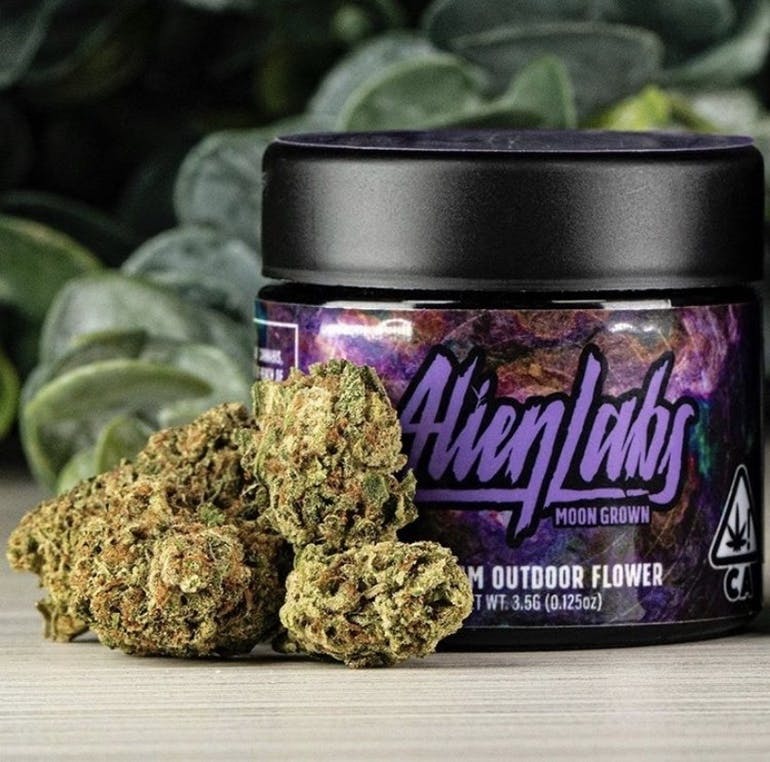
Sam: Alien Labs was an acquisition. It was a company that had built their brand really successfully in the gray market through 2017 and Prop 215 in California and had an incredible level of quality, a really loyal and dedicated fan base, not to mention a tremendous Instagram presence and following, which is where 98% of cannabis marketing happens today. We really loved the spirit of what the founders were bringing to the table. In 2018, we decided basically to join forces with them and bring them on board, creating a partnership where they leverage our infrastructure and the systems and processes we’ve built, but still keep their way of cultivation and their product vision. To this day, Ted Lidie, one of the founders, continues as the lead brand director for Alien Labs.

Aaron: In what geographies do you currently operate?

Sam: Our primary offices and facilities are based out of Sacramento, California, but we have facilities throughout the state. Last year, for the first time we launched operations in a new state, Arizona. As you may know, you’re not allowed to take cannabis products across state lines at all, so if you want consistent product in multiple markets you really have no choice but to rebuild your entire infrastructure in each state you want to open up.

There are many brands that are expanding and launching in more markets more quickly, but they’re doing so by taking product that’s already existing and putting their brand name on it. That is something we’ve decided strategically that we will not do. We’ve spent years building a high level of trust with our customers, so we’re only going to put our brand name on products that are our genetics, our cultivation, our style, our quality of product. When we launched in Arizona, we did it with a facility that we leased and took over and now operate with our staff. We’re replicating the same exact product that you can get in California in Arizona, which is really exciting.

We launched just this past November, which has been incredibly successful. Our dispensary partner Harvest saw lines of dozens of people out the door.“We consider ourselves a flower company first and foremost, so for us, that was a very calculated strategic move.”

Aaron: Any new geographies on the horizon that you can talk about?

Sam: We’re constantly evaluating new opportunities. I don’t have anything particularly specific to announce right now, but I will say we look for states where we believe there’s a competitive environment where the product quality is going to really stand out and be appreciated.

Aaron: Do you notice any differences in consumer trends between California and Arizona that stand out?

Sam: Not too many yet. We don’t have a retail location in Arizona, so we don’t have as much direct contact. However, we have heard consistently that the Connected customer demographics – as you would imagine most interested in our product – are those looking for something special, unique, different and have a really superior quality to everything else out there. We ended up launching in Arizona with the highest price point for flower in the state, and we say that’s just the beginning. The market is still so young and immature, both nationally and internationally, that this category is going to develop into one that’s really taste-driven.

Aaron: What’s next in California?

Sam: Continued growth and product development. We want to keep blowing away our customers with more and more incredible products, different product types and categories. For example, the cartridges were a really big launch for us because we don’t really consider ourselves a vape company. We consider ourselves a flower company first and foremost, so for us, that was a very calculated strategic move. We were only going to launch the product if we could fully replicate what the consumer gets from the flower experience. We are very unlikely to ever release a distillate pen, for example.

Aaron: What are you personally interested in learning more about?

Sam: We, as a society, really don’t know very much about the cannabis plant. Pretty much all meaningful research around cannabis stopped in the early 1900’s with prohibition. In the meantime, we’ve performed millions of dollars of studies and research on almost every other plant that we grow commercially. We understand these plants extraordinarily well. Cannabis science is stuck back in agriculture of early 1900s. The most interesting conversations I have are around how the plant works, how it doesn’t work and the ways in which it is so different from all other plants with which we are familiar. Our head of cultivation comes from Driscolls, the largest berry company in the world, and even he is frequently surprised by the way the cannabis plant reacts to things that are commonly understood in other plants. So, the way the actual plant responds to different environments is truly fascinating and something I think we’ll be learning about for decades and decades to come.

Aaron: Okay, great. That concludes the interview. Thank you, Sam!
extraction equipment

THC Remediation of Hemp Extracts

By Darwin Millard
1 Comment
extraction equipment

Remediation of delta-9 tetrahydrocannabinol (d9-THC) has become a hot button issue in the United States ever since the Drug Enforcement Agency (DEA) released their changes to the definitions of marijuana, marijuana extract, and tetrahydrocannabinols exempting extracts and tetrahydrocannabinols of a cannabis plant containing 0.3% or less d9-THC on a dry weight basis from the Controlled Substances Act. That is because, as a direct consequence, all extracts and tetrahydrocannabinols of a cannabis plant containing more than 0.3% d9-THC became explicitly under the purview of the DEA, including work-in-progress “hemp extracts” that because of the extraction process are above the 0.3% d9-THC limit immediately upon creation.

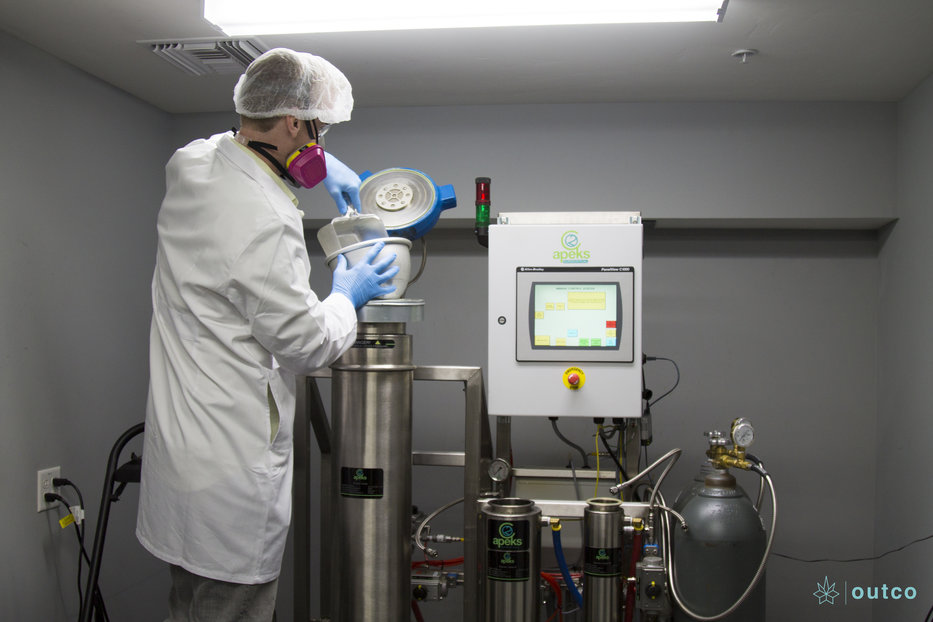
The legal ramifications of these changes to the definitions on the “hemp extracts” marketplace will not be addressed. Instead, this article focuses on the amount of d9-THC that is available in the plant material prior to extraction and tracks a “hemp extract” from the point it falls out of compliance to the point it becomes compliant again and stresses the importance of accurate track-n-trace protocols at the processing facility. The model developed to support this article was intended to be academic and was designed to follow the d9-THC portion of a “hemp extract” through the lifecycle of a typical CO2-based extract from initial extraction to THC remediation. A loss to the equipment of 2% was used for each step.

Initial Extraction

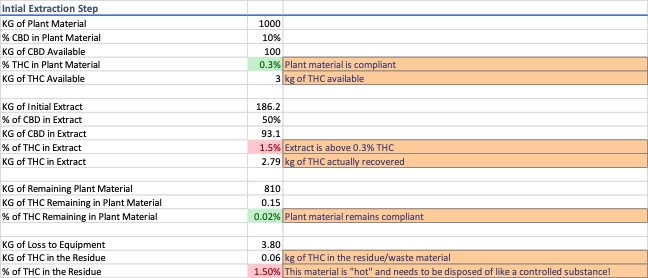
For this exercise, a common processing scenario of 1000 kg of plant material at 10% cannabidiol (CBD) and 0.3% d9-THC by weight was modeled. This amount, depending on scale of operations, can be a facility’s total capacity for the day or the capacity for a single run. 1000 kg of plant material at 0.3% d9-THC has 3 kg of d9-THC that could be extracted, purified, and diverted into the marketplace. CO2 has a nominal extraction efficiency of 95%, meaning some cannabinoids are left behind in the plant material. The same can be said about the recovery of the extract from the equipment. Traces of extract will remain in the equipment and this little bit of material, if unaccounted for, can potentially open an operator up to legal consequences. Data for the initial extraction is shown in Image 1.

Image 1: Summary Data Table for Typical CO2-based Extraction of Phytocannabinoids

As soon as the initial extract is produced it is out of compliance with the 0.3% d9-THC limit to be classified as a “hemp extract”, and of the 3 kg of d9-THC available, the extract contains approx. 2.8 kg, because some of the d9-THC remains in the plant material and some is lost to the equipment.

Dewaxing via Winterization and Solvent Removal

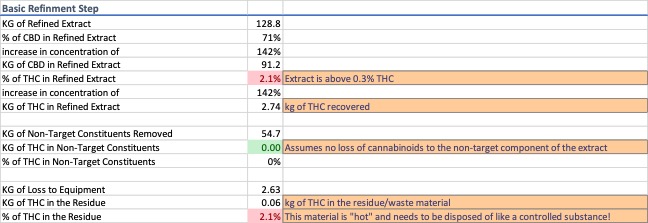
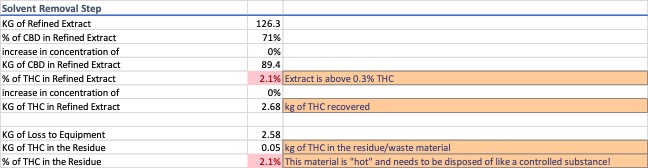
Dewaxing a typical CO2 extract via winterization is a common process step. For this exercise, a wax content of 30% by weight was used. A process efficiency of 98% was attributed to the wax removal process and it was assumed that 100% of the loss can be accounted for in the residue recovered from the equipment rather than in the removed waxes. Data for the winterization and solvent recovery are shown in Image 2 and 3.

Image 2: Summary Data Table for Typical Winterization of a CO2 Extract
Image 3: Summary Data Table for Solvent Removal from a CO2 Extract

Two things occur during winterization and solvent removal, non-target constituents are removed from the extract and there is compounded loss from multiple pieces of process equipment. These steps increase the concentration of the d9-THC portion of the extract and produce two streams of noncompliant waste.

Decarboxylation & Devolatilization

Most cannabinoids in the plant material are in their acid form. For this exercise, 90% of the cannabinoids were considered to be acid forms. Decarboxylation is known to produce a mass difference of 87.7%, i.e. the neutral forms are 12.3% lighter than the acid forms. Heat was modeled as the primary driver and a process efficiency of 95% was used for the conversion rate during decarboxylation. To simplify the model, the remaining 5% acidic cannabinoids are presumed destroyed rather than degraded into other compounds because the portion of the cannabinoids which get destroyed versus degrade into other compounds varies from process to process.

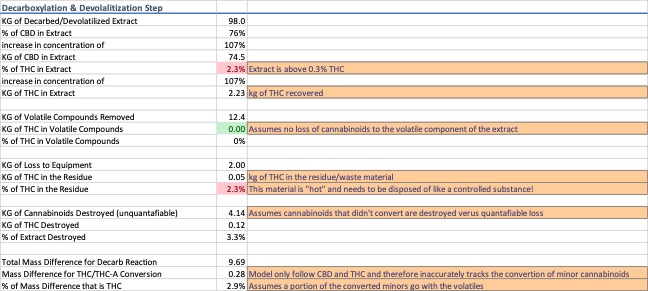
Devolatilization is the process of removing low-molecular weight constituents from an extract to stabilize it prior to distillation. Since the molecular constituents of cannabis resin extracts vary from variety to variety and process to process, the extracts were assumed to consist of 10% volatile compounds. The model combines the decarboxylation and devolatilization steps to account for complete decarboxylation of the available acidic cannabinoids and ignores their weight contribution to the volatiles collected during devolatilization. Destroyed cannabinoids result in an amount of loss that can only be accounted for through a complete mass balance analysis. Data for decarboxylation and devolatilization are shown in Image 4.

Image 4: Summary Data Table for Decarboxylation and Devolatilization of a CO2 Extract

As the extract moves along the process train, the d9-THC concentration continues to increase. Decarboxylation further complicates traceability because there is both a known mass difference associated with the process and an unknown mass difference that must be calculated and justified.

Distillation

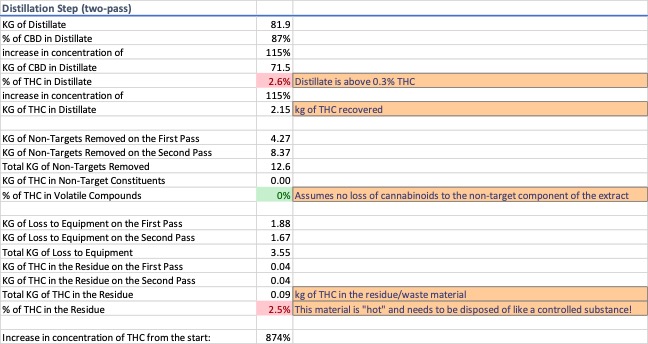
A two-pass distillation was modeled. On each pass a portion of the extract was removed to increase the cannabinoid concentration in the recovered material. Average data for distilled “hemp extracts” was used to ensure the model did not over- or underestimate the concentration of the cannabinoids in the distillate. The variables used to meet these data constraints were derived experimentally to match the model to the scenario described and are not indicative of an actual distillation. Data for distillation is shown in Image 5.

Image 5: Summary Data Table for Distillation of a Decarboxylated and Devolatilized Extract

After distillation, the d9-THC concentration is shown to have increased by 874% from the original concentration in the plant material. Roughly 2.2 kg of the available 3 kg of d9-THC remains in the extract, but 0.8 kg of d9-THC has either ended up in a waste stream or walking out the door.

Chromatography – THC Remediation Step 1

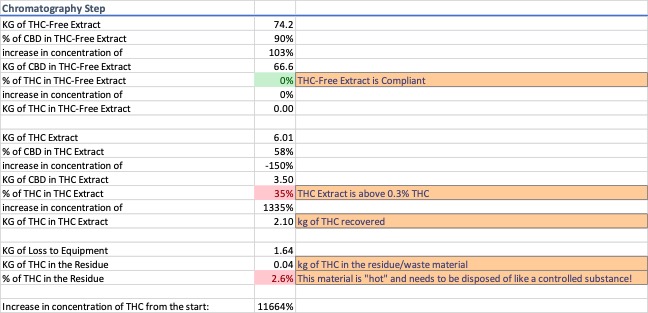
Chromatography was modeled to remove the d9-THC from the extract. Because there are several systems with variable efficiency rates at being able to selectively isolate the d9-THC peak from the eluent stream, the model used a 5% cut-off on the front-end and tail-end of the peak, i.e. 5% of the material before the d9-THC peak and 5% of the material after the d9-THC peak is assumed to be collected along with the d9-THC. Data for chromatography is shown in Image 6.

Image 6: Summary Data Table for d9-THC Removal using Chromatography

After chromatography, a minimum of three products are produced, compliant “hemp extract”, d9-THC extract, and noncompliant residue remaining in the equipment. The d9-THC extract modeled contains 2.1 kg of the available 3 kg in the plant material, and is 35% d9-THC by weight, an increase of 1335% from the distillation step and 11664% from the plant material.

CBN Creation – THC Remediation Step 2

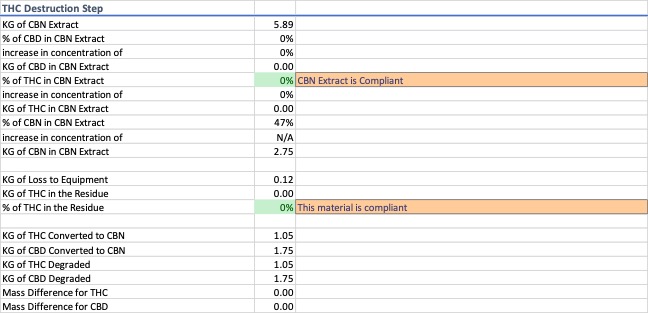
For this exercise, the d9-THC extract was converted into cannabinol (CBN) using heat rather than cyclized into d8-THC, but a similar model could be used to account for this scenario. The conversion rate of the cannabinoids into CBN through heat degradation alone is low. Therefore, the model assumes half of the available cannabinoids in the d9-THC extract are converted to CBN. The entirety of the remaining portion of the cannabinoids are assumed to convert to some form of degradant rather than a portion getting destroyed. Data for THC destruction is shown in Image 7.

Image 7: Summary Data Table for THC Destruction through Degradation into CBN

Only after the CBN cyclization step has completed does the product that was the d9-THC extract become compliant and classifiable as a “hemp extract.”

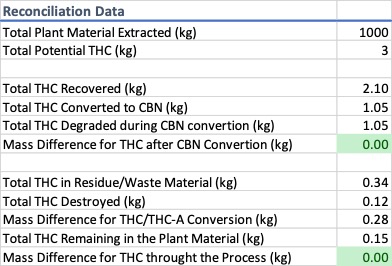
Image 8: Summary Data Table for Reconciliation of the d9-THC Portion of the Hemp Extract

Throughout the process, from initial extraction to the final d9-THC remediation step, loss occurs. Of the 3 kg of d9-THC available in the plant material only 2.1 kg was recovered and converted to CBN. 0.9 kg was either lost to the equipment, destroyed in the process, attributable to the mass difference associated with decarboxylation, or was never extracted from the plant material in the first place. All of these potential areas of product loss should be identified, and their diversion risk fully assessed. Not every waste stream poses a risk of diversion, but some do; having a plan in place to handle waste the DEA considers a controlled substance is essential. Without a track-n-trace program following the d9-THC and identifying the potential risk of diversion would be impossible. The point of this is not to instill fear, instead the intention is to shed light on a very real issue “hemp extract” producers and state regulators need to understand to protect themselves and their marketplace from the DEA.

Learning from the First Wave Part 2: California’s Cannabis Supply Chain and Vertical Integration, with a Grain of Salt

By Todd Feldman
No Comments

Part One of this series took a look at how the regulated cannabis market can only be understood in relation to the previous medical market as well as the ongoing “traditional” market. Part Two of the series describes how regulation defines vertical integration in California cannabis, and conversely, how vertical integration can address some of the problems that the regulations create. But first:

A Grain of Salt

Take the conventional wisdom about vertical integration with a grain of salt. Expected benefits may not materialize under the current circumstances:

  • Overall, the business environment is highly challenging due to extensive regulation, over taxation, insufficient retail capacity and competition from the “traditional” market. As a result, integrating businesses upstream or downstream may mean capturing losses, not profits.
  • The three major types of cannabis activity span three major industrial sectors: raw materials (i.e., cultivation), manufacturing and service (distribution, testing and retail). As a result, a vertically integrated company needs to carry out very different types of activity, which require very different types of core competencies, equipment and facilities.
    • Developing core competencies is especially challenging because each of the major cannabis sectors is still evolving.
    • Realizing the benefits of vertical integration requires an additional core competency in cross-sector operations.

 Regulations Define the Supply Chain

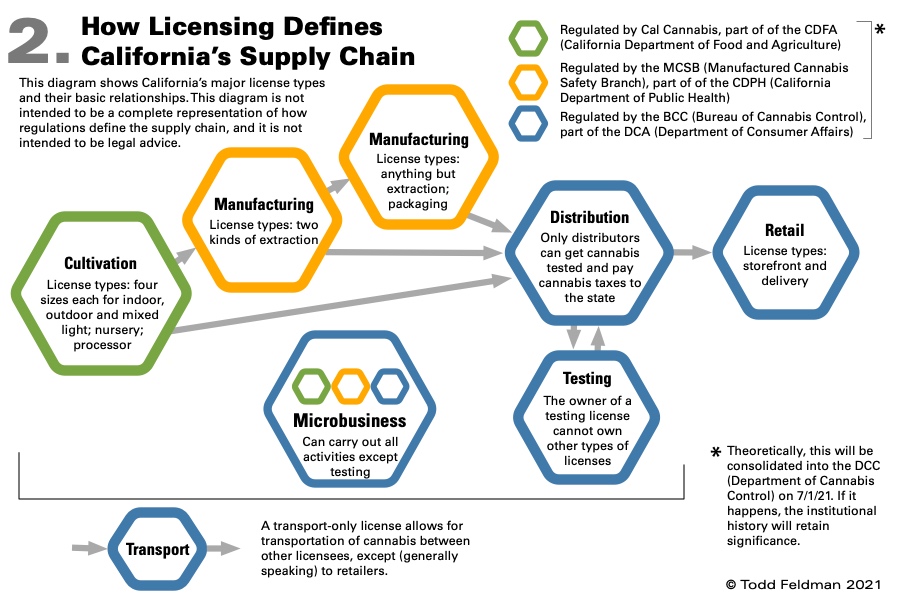
California’s regulations define the cannabis supply chain by defining both the individual links (licensees) and the relationships between those links. Therefore, an understanding of vertical integration must be grounded in an understanding of the underlying regulatory definitions.

The regulatory definition of each link is extensive. For example, each licensee is tied to a specific facility, and must have its own procedures for production, inventory control, security, etc. When the links are strung together, this definition tends to preserve operational redundancies, and impede operational integration.

Overall, the relationships between the links are primarily defined in terms of preserving the chain of cannabis custody. On top of that, regulations define very specific (and very consequential) links between certain licenses, as discussed below.

A Taxonomy of Links

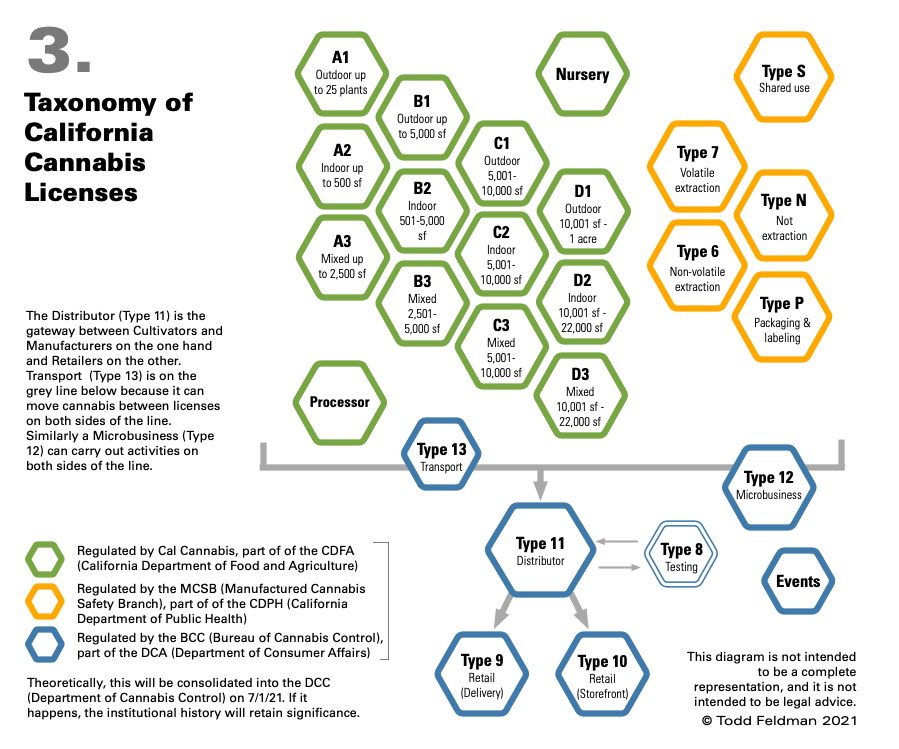
There are currently 26 types of cannabis license in California, 25 of which can be vertically integrated:

  • Cultivation – 14 licenses, including 4 sizes each for Indoor (up to 22,0000 sf), Mixed Light (up to 22,000 sf) and Outdoor (up to 1 acre), as well as Nursery and Processor (drying, trimming and packaging/labeling). Note that cultivation licenses are the only licenses that restrict the scale of activities.
  • Manufacturing – 5 licenses, including volatile extraction, non-volatile extraction, everything but extraction (i.e., infusion) and packaging/labeling.
  • Testing (Type 8), for testing cannabis according to state standards prior to sale. The owner of a testing license cannot own any other type of license.
  • Distribution (Type 11), acts as the gateway between cultivation and manufacturing on the one hand, and retail on the other. The distributor’s gateway status is entirely an artifact of regulation – cannabis must be officially tested before it is sold to a consumer, and only a distributor can order the official test. All products must stay in a “quarantine” area at the distributor until they pass testing. Products that fail testing must be destroyed if they cannot be remediated.
  • Transport (Type 13), which can move cannabis between licensees (with a narrow exception). This license does not allow for official testing.
  • Storefront Retail (Type 9), which is the best license to have, and the hardest one to get.
  • Delivery Retail (Type 10), for delivery services that are subject to the vagaries of software platforms and the intransigence of local authorities.
  • Microbusiness (Type 12), which allows the licensee to carry out cultivation (up to 10,000 square feet), non-volatile manufacturing, distribution and retail.
  • Event Organizer

Self-Distribution – A Case of Useful Integration

You may gather from the previous section that shoving a gratuitous and mandatory distributor into the middle of the supply chain creates problems for cultivators and manufacturers. Savvy operators solve this problem by getting a distribution license. This allows the cultivator or manufacturer to:

  • Pick the time and place for the testing of its cannabis products.
  • Avoid paying someone else for the storage of cannabis products as they await test results or purchase.
  • Reduce transport costs (particularly if the distributor is near the other operations).
  • Sell directly to retailers.

The bottom line is that vertical integration in California cannabis is useful as a means to an end, as opposed to an end in itself. Therefore, cannabis operators should carefully consider how vertical integration will benefit their core business before incurring the risks and expenses associated with an additional license.

This article is an opinion only and is not intended to be legal advice.

The (Arrested) Rise of Craft Cannabis in Canada

By Steven Burton
5 Comments

It’s no secret that the rollout of cannabis legalization has underperformed in countries like Canada. Since legalization in October of 2018, industry experts have warned that the projections of the big cannabis firms and venture capitalists far exceeded the expected demand from the legal market.

Today, major production facilities are closing down, some before they even opened, dried flower inventory is sitting on shelves in shocking quantities (and degrading in quality), and an extremely robust illicit market accounts for an estimated 80% of the estimated $8 billion Canadian cannabis industry. None of those things sound like reasons for optimism, but while some models for cannabis business are withering away, others are beginning to put down stronger roots. Crucially, we are beginning to see new business models emerge that will be able to compete against the robust black market in Canada.

The Legal Cannabis Industry Can’t Compete

Legal rollout in Canada could easily be described as chaotic, privileging larger firms with access to capital who were able to fulfil the rigid – and expensive – regulatory requirements for operating legally. But bigger in this case certainly did not mean better. The product these larger firms offered immediately following legalization was of a lower qualityand higher price than consumers would tolerate. In Ontario, cannabis being shipped to legal distributors lacks expiration dates, leaving retailers with no indication of what to sell first, and consumers stuck with a dry, poor quality product.

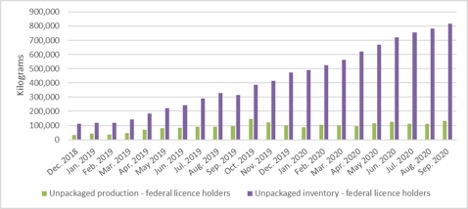
The majority of existing cannabis consumers across the country prefer the fresher, higher quality and generally lower priced product they can easily find on the illicit market. That preference couldn’t be clearer when you look at the growth of inventory, which is far outpacing sales, in the graph below:

Source: Government of Canada

Which brings us to the crux of the matter: when it comes to building up the Canadian cannabis industry, what will succeed against the black market that has decades of expertise and inventiveness behind it?

Rising From the Ashes: Craft Growers and Other Small-Scale Producers

The massive facilities like Canopy’s may be shutting down, but our friends over at Althing Consulting tell us that those millions of square feet facilities are being replaced by smaller, more boutique-style cultivation facilities in the 20,000 ft tier, which are looking to be the future of the industry.

Consumers have consistently shown a strong preference for craft cultivators and other small-scale producers who produce higher quality, more varied products that are more responsive to consumer needs. It also hasn’t hurt that prices are also coming down: Pure Sun Farms in Delta, BC is consistently selling out of their $100/ounce special, which is highly competitive even with the illicit market.

This vision of the industry matches up better with the picture we’ve been getting from other legalization projects around the world. It also squares with other indicators of success. Despite the small market capture of the legal market, industry employment numbers are still relatively high, especially when compared with more established legal consumer products markets such as beer. In fact, craft cannabis growers now employ nearly as many people as the popular craft brewing sector here in British Columbia.

But in order to make the craft cannabis market actually competitive in both the regulated and unregulated spaces, the government will have to address four major challenges.

Challenge #1: License Distribution is Uneven and Chaotic

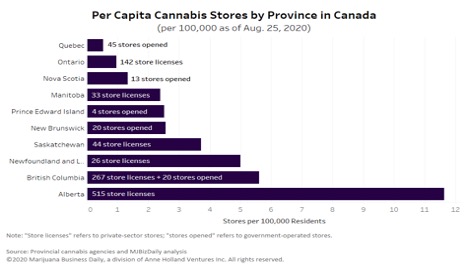
A December 2020 report by Ontario’s auditor general contains admissions by the Alcohol and Gaming Commission of Ontario (AGCO), Ontario’s cannabis industry regulator, that they lack the capacity and resources to manage the number of applications for private cannabis retailing. Problems relating to the issuing of licenses, including long delays and difficult requirements, are widespread across provinces. One way this becomes clear is by looking at the very uneven distribution of stores across the country in the graph below.

Source: MJBiz Daily

Challenge #2: Basic Regulatory Compliance is Complex and Time-Consuming

Smaller-scale micro cultivators, whose good quality craft product remains in high demand, still face prohibitive barriers to entry into the legal market. Licensing from Health Canada is one onerous challenge that everyone must tackle. Monthly reporting requirements have in excess of 477 compliance fields. Without additional support to navigate these requirements – including automation technology to ease the administrative burden – these smaller producers struggle to meet the minimum regulatory standards to compete in the legal market.

Challenge #3: A Long-Distance Road to Compliance and Safety Means Higher Costs

Even with all regulatory requirements satisfied, cannabis cultivators can’t sell their product from “farm to fork” (to borrow a phrase from the food industry). Many growers ship their product to be irradiated in order to ensure they are below the acceptable microbial threshold set by Health Canada. While irradiation positively impacts the safety of the product, new evidence shows that it may degrade quality by affecting the terpene profile of the plant. Furthermore, only a few facilities in Canada will irradiate cannabis products in the first place, meaning that companies have to ship the finished product sometimes thousands of kilometers to get their product to market.

Next year, Health Canada looks set to lower the limit on microbials, making it virtually impossible to avoid cannabis irradiation. If Health Canada follows through, the change will be a challenge for small-scale cultivators who strive to prioritize quality, cater to consumers who are increasingly becoming more educated about terpene profiles, and seek to minimize the environmental impact of production.

Challenge #4: It is Virtually Impossible to Market Improved Products

Finally, there is a marketing problem. Even though the regulated market has made dramatic improvements in terms of product quality from legalization two years ago, Health Canada’s stringent marketing restrictions means that cannabis producers are virtually unable to communicate these improvements to consumers. Cannabis producers have little to no opportunity to reach consumers directly, even at the point of sale – most legal sales are funneled through government-run physical and online stores.

What Can a Thriving, Legal Cannabis Market Look Like in Canada?

The good news is that change is being driven by cannabis growers. Groups like BC Craft Farmers Co-Op are pooling resources, helping each other navigate financial institutions still hostile to the cannabis trade, obtain licenses and organizing craft growers to advocate to the government for sensible regulatory changes. As a result of their advocacy, in October, the federal government initiated an accelerated review of the Cannabis Act’s restrictive regulations related to micro-class and nursery licenses.

Now, more co-op models are popping up. Businesses like BC Craft Supply are working to provide resources for licensing, quality assurance and distribution to craft growers as well. Indigenous growers are also showing us how cannabis regulation could work differently. Though Indigenous cultivators currently account for only 4% of Canadian federal cannabis licensees (19/459), that number looks to be growing, with 72 new site applications in process self-identified as Indigenous, including 27 micro cultivators. In September, Williams Lake First Nation entered into a government-to-government agreement with the province of British Columbia to grow and sell their own cannabis. The press release announcing the agreement includes the following statement:

“The agreement supports WLFN’s interests in operating retail cannabis stores that offer a diverse selection of cannabis products from licensed producers across Canada, as well as a cannabis production operation that offers farm-gate sales of its own craft cannabis products.”

More widespread adoption of the farm-gate model, which allows cultivators to sell their products at production sights like a winery or brewery, has a two-fold benefit: it better supports local, small-scale producers, and it offers opportunities in the canna-tourism sector. As the economy begins its recovery alongside vaccine rollouts and restrictions on travel ease, provincial governments will have the chance to leverage the reputation of unique regional cannabis offerings (i.e. BC bud) through these farm-gate operations.

While the cannabis legalization story in Canada has had its bumps, the clear path forward for greater legal market success lies in increased support for micro-cultivators. By increasing support for these small-scale producers to navigate regulatory requirements, more will be able to enter the legal market and actually compete against their illicit counterparts. The result will be higher quality and more diverse products for consumers across the country.

Hardware Platforms in Cannabis: A Q&A with Mike McDonald, President and CEO of Ammonite

By Aaron Green
No Comments

More and more we are seeing the development of proprietary hardware platforms in cannabis. With proprietary technology in hand, manufacturers often lean on MSOs, LPs and other brand partners to grow their business through existing sales channels.

We spoke with Mike McDonald, President and CEO at Ammonite, to learn more about the history of the Dablicator™ platform and Ammonite’s North American brand partner strategy. Mike formed Ammonite as a spin-off company from Jetty Extracts after getting to know the founders in a real estate transaction. Prior to Ammonite, Mike was an operator in the manufacturing and product development space, having helped to launch the Giant bicycle brand as well as growing and eventually selling the Atlas Snowshoe Company to K2 Sports.

Aaron: How did you get involved in cannabis?

Mike: Well, like a lot of folks in the industry, my background is pretty eclectic. I come primarily from an operator’s perspective – I’ve been in manufacturing, product development and company growth for my whole career. I lived in Taiwan for several years and helped to launch the Giant bicycle brand worldwide. I was also involved with a ski business that was started at Stanford as a thesis project called Atlas Snowshoe Company. Fast-forward, we built it into the largest snowshoe brand and activity in the US and later sold it to K2 Sports. So, I’ve always been involved in the growth of product-related businesses.

Mike McDonald, President and CEO at Ammonite

I’ve also done some real estate development as well; I actually sold our building to the Jetty guys, which is how we met. In that process, I got involved with their company, helped Jetty reorganize its business model, raise some money, and then just got addicted to the whole industry and really found it fascinating. I liked the team at Jetty and couldn’t resist jumping in, and now I’ve been full-time in the business for over three years.

Aaron: How did you get involved in Ammonite?

Mike: Ammonite is actually a spin out company from Jetty Extracts, which is one of the largest brands in California. Our main Ammonite product is called the Dablicator™ Oil Applicator, which was originally invented at Jetty as a medical device for cancer patients. We saw a big demand for it as a private label partnership product, so we decided to spin out a separate hardware company and really focus on developing unique IP and CBD and cannabis related hardware.

Aaron: What trends are you following in the industry?

Mike: Certainly the MSOs of the world are really expanding and the top three to five are making a mark with growth and more sophistication in the market. I think the social equity movement is really a big component that we’re all excited about in the industry. You’re seeing the larger players really put their money where their mouth is around that. We’ve always been a big part of that in California.

Specifically, regarding trends in the cannabis space, Colorado and California are probably the two most mature markets. We generally say what’s happening in California and Colorado eventually make their way out to the rest of the world. Vaping was invented in California and Colorado, and now it’s a huge part of the business where before, four or five years ago, the market was mostly flower-centric.

There’s a trend away from inhalables, with more awareness around lung-related illnesses and of course COVID, so we’re seeing a big growth in edibles, drinks and so forth. Interestingly enough, although it’s an inhalable, infused pre-rolls are a big growth sector as well. Jetty is actually launching an infused pre-roll program in February.

Folks are looking for ways to get their medicine without smoking – and this has definitely led to a growth in the oil application business. Oil application has traditionally been delivered via a syringe. Dablicator™ oil applicator is essentially an improved, more convenient syringe. On the medical side, patients have been taking oil sublingually, putting it in food and drink and so forth for years because a lot of them can’t smoke. As that trend transfers over to the adult use market, oil application is becoming really big. You can take it sublingually; you can put it in your food or beverage. On the recreational side, you can add it to your loose flower or joints, or of course, dab it directly onto your rig via the heat resistant tip.

Further, you’re probably familiar with a lot of these portable dab rigs that are taking off, like the G Pen Roam and the Puffco Peak and a variety of others. So now you can dab on the go with your standard wax and shatter in a jar. It’s just not the most convenient way if you’re up on a hike or on a mountain bike ride. So now, with a portable dab rig and something like the Dablicator™ oil applicator, you can have a really convenient mess-free way to enjoy cannabis. The big growth in concentrates and areas that aren’t necessarily inhalables is where our product hardware really fits in.

Aaron: How did you come up with the idea for the Dablicator?

Mike: The Jetty team had a friend that had brain cancer. He was doing a lot of chemotherapy and was having trouble eating and keeping weight on and he couldn’t smoke. So, the guys at Jetty began to bring him cannabis oil, which he was able to use ingesting it from a spoon initially and it really helped him with his pain, his anxiety and his appetite. In that process, we realized that there wasn’t really a great way to deliver oil. Syringes were there, but they were kind of sketchy and they weren’t convenient.

So, the Jetty team developed a better mousetrap. Several iterations later, this Dablicator™ product was ready for patients. In fact, it became a big part of the Jetty Shelter Project, a non-profit where the team delivers cannabis to cancer patients, and it was a very much sought-after product delivery device in that world. So, it was developed inside of a need on the medical side and it’s really sort of grown inside the expansion on the adult-use side.

Aaron: Can you explain how the Dablicator™ oil applicator works from a perspective of form and function?

Mike: Pre-Dablicator™ you would use a syringe type product – for direct oil application, sublingual application, or as an add on to your flower. The difference between Dablicator™ oil applicator and a traditional syringe is that Dablicator™ is a twist and plunge product. Imagine a pen filled with oil, but instead of inhaling it, you’re able to dispense it through a tip that is heat resistant, which means you can apply directly to your dab rig nail. You’re able to put it in your pocket without fear of cannabis oil leakage. It’s discreet, precise, compact and portable.

Aaron: How does the user dose using Dablicator™ oil applicator?

Mike: Basically, there’s measurements on the plunger of 55 milligrams apiece – one click is 55 milligrams, and you can dispense as many clicks as you like. What’s cool about the product itself is if you’ve clicked too many times accidentally, you can back it off and the excess oil won’t dispense. You can go to dablicator.com and see demo videos as well.

Aaron: Dablicator™ oil applicator started as a Jetty Extracts spin-off. I see you are now white labeling for other oil brands. How do you go about selecting your partners?

Mike: We call it our brand partner program. It’s not too dissimilar to what other hardware manufacturers, like PAX and GPen, are doing. We’ve got a patented and innovative device where our brand partners, MSOs and leading brands throughout the US and Canada, can take their existing vape and tincture oils and offer them in Dablicator™ oil applicator hardware.

Our focus is signing up major, well respected brands and MSOs on to the “platform,” meaning they are able to immediately offer between six and ten new SKUs to their consumers. They take their existing oils, put them into a custom branded Dablicator™ hardware unit and add their custom branded packaging. It’s a full turnkey solution. For example, one of our partners, 710 Labs, is developing their RSO and were shopping for a delivery method specifically geared towards medical patients. Within eight weeks, we had a custom program for them and delivered hardware, and we assisted on the packaging front as well.

Our partners have to be reputable folks that are interested in developing or delivering oil in a unique and innovative way. Frankly, our early partners are those that see where the growth is. 710 Labs is on the platform, as well as Surterra in Florida, Ancient Roots in Ohio, and we’ve got multiple conversations going to some of the other MOSs and the LPs in Canada.

Aaron: Are the brand partners loading the oil applicator themselves?

Mike: We customize the product for them and then ship them unassembled and empty. In their lab, they use the same machinery and equipment they use to fill their vape cartridges. They then fill their Dablicator™, assemble it, package it and ship it out just like any other product that they’re processing and manufacturing.

Aaron: What kind of oils are suitable for Dablicator™?

Mike: Pretty much any oil that’s going into a vape cart is suitable and then some. Some of our customers, including Jetty, started out with a THC distillate. Live resin is becoming a big product category in California as well as solventless oils. Dablicator™ oil applicator can accommodate everything from distillate to live resin to solventless to RSO and even full spectrum CBD. If it can flow, if it doesn’t crystallize up like shatter and sugars and diamonds, you can put it into Dablicator™, even the thickest of oils. It’s designed to contain any kind of liquids that are flammable.

Aaron: What geographies are you currently in?

Mike: We’re in multiple states throughout the US and actually just signed up with an LP in Canada. We only launched the program in August of 2020, and today we’ve got partners California, Colorado, Ohio, Arizona, Missouri, Florida, soon to be Michigan, Illinois, and throughout Canada.

Aaron: Any plans for international expansion beyond North America?

Mike: We’re getting inquiries on a regular basis from all over the place, including internationally. We’re in conversations with some folks down in Brazil. Spain is actually a big cannabis market and we’re having some conversations with some folks there. The inquiries are coming in faster than we can process the relationships, but right now our major focus is on North America.

Aaron: What are your goals with Ammonite?

Mike: We are developing a category, right? So today, oil dispensing isn’t top of mind. Today, if you want oil, you go into a dispensary and say, “Hey, give me those syringes.” My goal is that a year from now, you can walk into Harborside in Oakland and you see a wall of different branded Dablicator™ oil applicators. The goal is to really turn the oil dispensing business into a category, and then position Dablicator™ oil applicator as the best and leading product in that category.

Aaron: What are you personally interested in learning more about?

Mike: Well, I’ve got two teenagers – two daughters, as a matter of fact, a freshman and a senior – and they’re being homeschooled right now. So that’s been quite an interesting development!

I think on the cannabis side, it’s just fascinating what it is as a business model. It’s the most recent multi-billion-dollar opportunity in consumer products. You only get a chance to participate in something like that maybe once in a lifetime. I’m really looking forward to seeing it become more adopted into the mainstream and it’s already becoming that way from a consumer perspective. I am watching the cannabis market become legal from a federal perspective, hoping that the social equity component of the industry really stays with it.

I’ve been in a lot of businesses over the years; I feel like one of the gray hairs in this business that is actually an operator versus someone who came over from the financial side. I am continuing to learn, grow and work with great people and this has been a really amazing experience for me.

Aaron: Okay, great. Mike, that’s the end of the interview. Thank you for your time today!

Learning from the First Wave Part 1: How Law Shapes the California Cannabis Industry

By Todd Feldman
No Comments

As a cannabis lawyer, I spend a lot of time thinking about the ways that regulations affect a cannabis company’s bottom line. Since I’m in California, the ways are many.

In late 2017 I became the chief compliance officer for an Oakland startup that carried out delivery, distribution, cultivation and six manufacturing operations. A big part of my job was preparing my company, along with several equity cannabis companies, for California’s First Wave of cannabis licenses.

For the most part, First Wave licensees came from California’s essentially unregulated medical cannabis market, and/or from California’s by-definition unregulated “traditional” market. When California began issuing licenses in January 2018, many First Wavers were unprepared because their businesses practices had evolved in an unregulated market. A big part of my job was to help them adapt to the new requirements. As a result, I saw the regulations, and the effects of regulations, in sharp relief.

Regulation touches virtually every aspect of the legal cannabis industry in California. So anyone who wants to understand the industry should have at least a basic understanding of how the regs work. I’m writing this series to lay that out, in broad strokes.

Some key points:

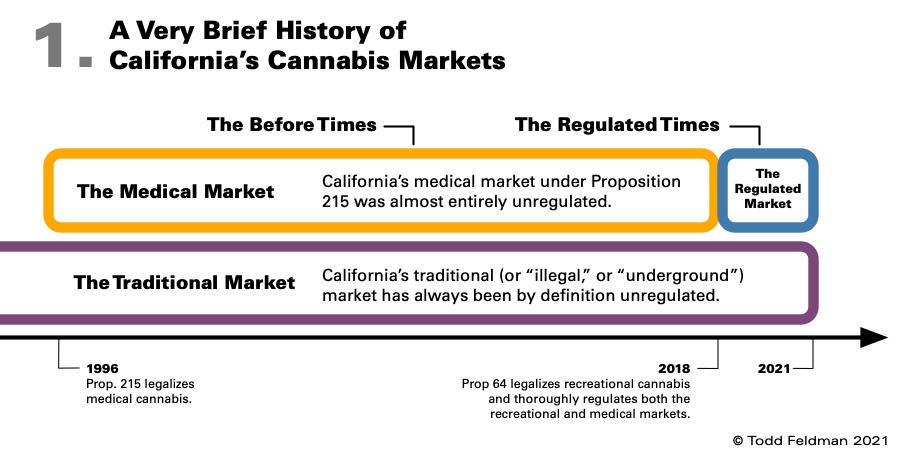
  • The regulated market must be understood in relation to the previous unregulated (medical) market as well as the ongoing traditional market.
  • Regs define the supply chain.
  • Regs are designed to ensure product safety and maximize tax revenue.
  • Many regulations mandate good business practices.
  • Local enforcement of building, health and safety codes tends to be zealous and costly.

A Tale of Three Markets

California’s regulated cannabis market can only be understood in relation to the medical market that preceded it, and in relation to the traditional market (illegal market) that continues to compete with it.

The Before Times

California’s legal medical cannabis market goes back to 1996, when the Compassionate Use Act passed by ballot measure. One fact that shaped the medical market was that it was never just medical – while it served bona fide patients, it also served as a Trojan horse for adult-use (recreational) purchasers.

Another fact that shaped the medical market was a near complete lack of regulation. On the seller’s side, you had to be organized as a collective. On the buyer’s side, you had to have a medical card. That was it.

Meanwhile, the cannabis supply chain was entirely unregulated. This tended to minimize production costs. It also meant that a patient visiting a dispensary had no way of verifying where the products had been made, or how.

The Regulated Times

Licensing under the Medical and Adult-Use Cannabis Regulation and Safety Act (the “Act”) began on January 1, 2018. It was the beginning of legal adult-use cannabis in California. It was also the beginning of the Regulated Times, as the Act and accompanying 300-plus pages of regulations transformed the legal cannabis market.

 For example:

  • The Act defines the cannabis supply chain (as a series of licensees).
  • Across the supply chain, the internal procedures of cannabis companies are subject to review by state agencies;
  • Cultivators and manufacturers cannot sell directly to a dispensary – they must go through a distributor;
  • All cannabis must be tested for potency and a long list of contaminants by a licensed testing laboratory before it may be sold to consumers;
  • And beginning in 2019, all licensees were required to participate in the California Cannabis Track and Trace (CCTT) program, which is designed to track all cannabis from seed to sale.

Just as importantly, the Act establishes a dual licensing system – that is to say, in order to operate, a cannabis company needs a local permit (or other authorization) as well as a state license. In fact, local authorization is a prerequisite for a state license. And your local jurisdiction will have its own rules for cannabis that apply in addition to the state rules, up to and including a ban on cannabis activities.

Needless to say, operating in the Regulated Times is a lot more complicated and expensive than it was during the Before Times.

Especially when you consider the taxes. For example, in the City of Los Angeles, sale of adult-use cannabis is taxed at 10%, which means that any adult-use purchase in L.A. gets a 34.5% markup:

  • 15% state cannabis excise tax, plus
  • 10% Los Angeles Adult Use Cannabis Sales tax, plus
  • 5% sales tax.

Note that the distributors must collect the excise tax from the retailer, so the 15% markup is not necessarily visible to the consumer. Similarly, consumers are generally unaware that there is a cultivation tax of $9.65 per ounce (or about $1.21 per eighth) of dried flower that the distributor has to collect from the cultivator.

Theoretically, all of this might be unproblematic if licensed retailers were only competing with each other. Which brings us to:

The Traditional Market

The traditional market is the illegal market, which is to say, the untaxed and unregulated market.

Legalization of adult-use cannabis was supposed to destroy the traditional market, but it hasn’t. As of early 2020, the traditional market was estimated to be 80% of the total cannabis market in California. This is not surprising, since the traditional market has the advantages of being untaxed and unregulated.

The traditional market has a pervasive negative effect on the legal market. For example, the traditional market tends to depress prices in the legal market and tends to attract talent away from the legal market. Some of these effects will be discussed in the following articles.

This article is an opinion only and is not intended to be legal advice.

CA Health and Safety Warning Laws Have Changed: Are You In Compliance?

By Megan Caldwell, Lindy Martinez
1 Comment

A new California Proposition 65 mandate took effect on January 3, requiring health warning labels for all cannabis products sold in the state. Failure to comply with the requirements can and will result in enforcement against cannabis producers and sellers, resulting in hefty penalties. Here’s what you need to know.

Some Background on Proposition 65 and Cannabis

California’s Proposition 65, also known as the “Safe Drinking Water and Toxic Enforcement Act of 1986,” requires various parties in the supply chain for consumer products to provide warnings on products they sell in the state if exposure to certain chemicals in those products will pose a significant risk of cancer or reproductive harm. Proposition 65 applies to any company that sells products in California, regardless of whether the business is headquartered or manufactures products in California.

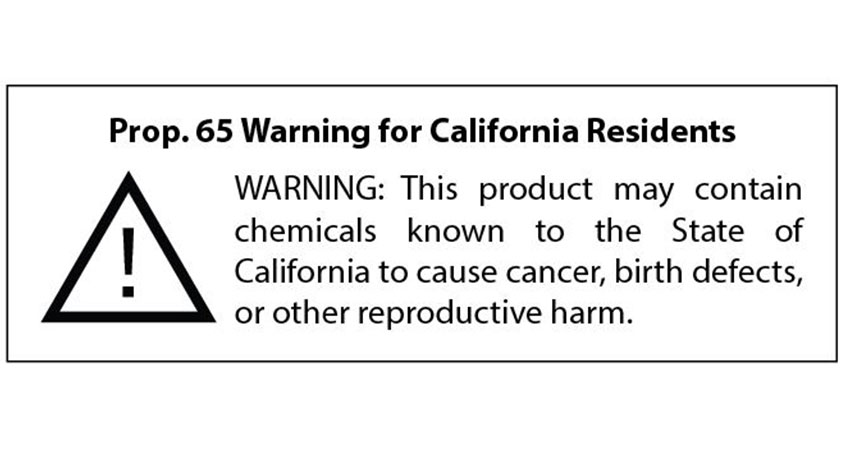
This is an example of a Prop 65 warning label. They might look familiar because we tend to see them on a lot of common goods and products.

“Cannabis (Marijuana) Smoke” was listed under Proposition 65 in 2009 because of the potential that it contains ingredients or emits chemicals known to cause cancer. These chemicals include toxins such as arsenic, benzene, cadmium, formaldehyde, lead and nickel. In January 2020, Delta-9-Tetrahydrocannabinol (THC) was added to the list of toxic chemicals under Proposition 65 because of THC’s potential to cause reproductive harm. Now, both THC and cannabis smoke are listed under Proposition 65 and require warning labels.

What This Means for You and Your Company

The updated chemical list, which includes THC, became effective January 3, 2021, so the clock to come into compliance is ticking if you are not already complying. Many cannabis companies selling in California already comply with Proposition 65 by including warnings on their products that emit cannabis smoke. However, now companies that have previously issued a consumer warning regarding cannabis smoke must expand their warnings to include both the potential risk of cancer and the potential risk of reproductive harm. Additionally, products that previously did not require a warning for cannabis smoke will now be subject to Proposition 65 for exposure to THC.

The listing of THC implicates a broader range of cannabis products because it affects any product that contains detectable levels of THC, including products that contain less than 0.3% THC in compliance with the 2018 Farm Bill. Under the THC listing, a wide range of cannabis and hemp-derived CBD products, including products that do not emit smoke, such as edibles, topicals and other concentrates are subject to the Proposition 65 labeling requirements.

The agency that oversees Proposition 65 has provided so-called “safe harbor” levels for many listed chemicals that allow companies to forego a warning label if exposure to the chemical occurs at or below a certain threshold. However, no safe harbor level has been established for cannabis smoke or THC, and so the burden falls to the business to determine if the levels of the chemical pose a significant risk to the consumer. This determination typically requires extensive and costly testing that is not practical for most businesses. Thus, parties in the cannabis supply chain should work to properly label all cannabis-related products at this time. Failure to do so is risky. Proposition 65 “bounty hunters” team up with individuals to enforce Proposition 65 by sending notice of violation letters and then often filing lawsuits against businesses they believe are in violation of the statute. Many of these demands and lawsuits settle, as the cost to litigate is expensive. Settling, though, can be expensive, too.

Due Diligence for Suppliers & Cannabis Supply Chain Partners

By Mark Slaugh
1 Comment

Between the patchwork quilt of rules and regulations that is the modern cannabis industry, products pass through many hands before being sold to a customer. From sourcing, cultivating, manufacturing, distributing and vending, the relationships between a licensee and their vendors/partners up and down the supply chain is complex and touches many stakeholders along the way.

While the focus on quality packaging, dope labeling, delicious ingredients and consistently potent cannabis is a priority for most companies, what often isn’t thought about is the liability in bringing these components together in terms of compliance.

Compliance responsibility falls on licensees as a direct term and condition of licensure within their state. To operate, licensees must maintain and be able to demonstrate compliance with a plethora of rules and regulations. Compliance is the name of the game in cannabis.

While most operators understand this, what most do not think about is how the compliance or noncompliance of their vendors affects their own liability.

Sharing Noncompliance & Liability

Supply chain partners are automatically segregated by whether or not they are plant touching licensees or not.

Licensees are the only entities in the supply chain that can be fined, administratively held, suspended, revoked or even arrested due to noncompliance. This fundamental nature means that supply chain partners are automatically segregated by whether or not they are plant touching licensees or not.

In the case of mutual licensees such as a manufacturer and dispensary, the liability for compliance falls on both entities. A single manufacturer that makes an error on labeling language or a cultivator using the incorrect containers both pass on their liability to any downstream partners.

iComply has seen regulators quarantine hundreds of products among multiple dispensaries who never checked the compliance of the supplying manufacturer. Surprisingly, most dispensaries don’t think of the liability passed to them amid hundreds of SKUs and multiple manufacturers and cultivators. Confounding the issue further is that everyone in the industry can interpret the same rules in completely different ways.

Assuming your supply chain partners are 100% compliant is a dangerous pitfall.

By not checking noncompliance from supply chain partners, operators accumulate evidence dating back years. Like METRC being off, these issues tend to snowball until they seem overwhelmingly difficult to handle. And it doesn’t just stop at labeling issues. Noncompliance can fall on all supply chain partners and be left in the hands of a licensee in a variety of ways.

Business partners like security contractors can often run afoul of regulations and put their licensed partners at risk.

Even worse, are supply chain partners who don’t have a motive to be compliant as they do not own licenses and often have a poor understanding of cannabis compliance. A packaging provider, marketing company, CBD provider, security company, vending machine providers, waste disposal companies and other commonplace suppliers and partners can often run afoul of regulations and put their licensed partners at risk.

Since regulators can only enforce the licensed entity, many states have made it clear that licensees are ultimately and fully responsible for any actions of noncompliance taken by third parties contracted by the company – regardless if they touch cannabis or not.

Areas of Common Noncompliance in Cannabis

Like a game of “Hot Potato” (worth millions of dollars), we’ve seen common noncompliance liability get passed down the supply chain in the following areas of cannabis operations:

  • Product liability
  • Packaging and labeling
  • Test result manipulation
  • Expired licenses
  • Input or ingredient defects
  • Inventory tracking errors
  • Recordkeeping and manifest errors

Some of these areas of noncompliance rely with non-licensed supply chain partners such as packaging, ingredients or third party printed labels. Often, these folks simply don’t know what they don’t know and make mistakes – not knowing the thousands of dollars they could be costing their licensed partner down the line.

Other areas in which compliance should be expected from licensed partners lies in product liability, test result issues, inventory tracking, manifests and recordkeeping. No one usually wants to be out of compliance and usually these issues arise from licensed partners who are simply confused, mistaken or ignorant to the requirements of ongoing and changing rules.

It’s hard to keep all of one’s suppliers and supply chain partners on the same page over the long run and amid a multitude of changing rules. But what you resist, persists…

Managing Compliance in the Cannabis Supply Chain

Nothing worth it is ever easy; but it is possible to identify common areas of noncompliance in one’s cannabis operation and supply chain partners and to do something about.

To identify problem areas, iComply recommends conducting regular auditing at a macro level; but to also dive deeper into micro level audits of all of one’s books and records (covering vendor files) and packaging and labeling for at least 12 months.

You don’t know what you don’t know, so one must begin by investigating and understanding where liabilities are occurring between themselves and their supply chain partners. Once valid feedback and noncompliance is discovered, it can be remediated.

Like triage, you have to stop the bleeding before you can prevent further injury.

Consistency in quality standards requires meticulous SOPs

It is always more expensive and time consuming to continue reacting to noncompliance and trying to fix issues after the fact. This is how snowball effects happen until the problems seem so overwhelming, operators tend to simply ignore the liability. While it is human nature, it is also extremely dangerous and detrimental when multimillion dollar licenses are on the line.

An ounce of prevention is worth a pound of cure –Benjamin Franklin

By implementing proactive compliance measures, cannabis businesses can avoid costly noncompliance consequences and position themselves as proactive checkpoints of supply chain compliance. We recommend integrating the following procedures, documents, training and tools into one’s operational compliance infrastructure:

  • New vendor checklist
  • Packaging and labeling checklists by product type
  • Virtual review of labels/non-cannabis packaging
  • Calendar expiration dates for licenses and products
  • Compliance auditing of key vendors and strong contracts regarding liability
  • Input product checklists and tracking as per GMP compliance

This snapshot is just the tip of the iceberg when it comes to the depths of liability a cannabis business is exposed to by its supply chain partners. To truly manage compliance, one must be aware of shared risk and implement proactive measures to prevent suppliers and supply chain partners from inadvertently affecting the operational compliance of your cannabis business.

Selecting Supply Chain Partners

There are plenty of fish in the sea and plenty of suppliers vying to do business with you. iComply has seen the good, the bad and the ugly. We’ve been on the front lines of developing markets like California where we warned our clients to steer clear of companies like Kushy Punch long before they finally lost their license for noncompliance.

control the room environment
Preventing contamination can save a business from extremely costly recalls.

We advise our clients on the importance of being selective and conducting due diligence in vetting supply chain partners and vendors. Most fundamentally, how aligned are the values of potential partners? Are they in the business for the same reasons you are? What brought them to the cannabis space? How do they value relationships and what do they know about compliance?

Too often when focused on price or speed, people miss the more important fundamentals of relationships. We serve as vetters for our clients whether they are shopping for a POS provider, a bank or a waste disposal company. Beyond the cultural alignment, the more objective questions begin to take shape in vetting a potential partner. This can differentiate between license holding and non-holding supply chain partners.

For plant-touching licensed partners, we recommend answering the following before entering into business partnerships that affect your supply chain:

  • Copies of licenses, contracts, and a catalogue of products
  • For products being selected, prior to ordering a sample, obtain a copy of the label by email first. Or an EMPTY sample of product packaging and labeling to vet against a packaging and labeling checklist.
  • Search news articles on the company and ask if they have had compliance issues before. Obtain documentation if there have been compliance issues previously.
  • Ask how they manage their compliance and prevent noncompliance down their supply chain. Do they train their staff? Do they conduct regular audits internally? How often do they update SOPs and reconcile inventory?

For non-plant touching partners, we recommend answering the following:

  • Obtain any certifications for quality assurance or in credentials for services.
  • Ask for references from other customers who have cannabis licenses.
  • Discover how familiar they are with the cannabis industry AND the rules and regulations in your market.
  • Ensure they have an understanding of how they impact your compliance. Discover how they plan on preventing areas of concern together.
  • Make sure they know you are ultimately responsible for noncompliance and understand what they are willing to do to protect you.

Ensuring accountability across the supply chain means selectively choosing partners who share the same values of integrity and professionalism. On more complicated deals, such as licensing IP or your brand to operators in new states or markets, we recommend that you mandate a compliance program that offers third-party validation to ensure the internal integrity of your partners. Too often, brand risk isn’t considered in the fast-paced expansion of the industry and operators must not only be vetted, but held accountable, when representing one’s brand and products.

For all intents and purposes, the wild web of the supply chain in cannabis is the industry. We are a collective of collaborators who all serve the goal of delivering high quality and safe products to cannabis consumers globally. For those committed to minimizing their risk to protect their profits, cannabis compliance is the key to success.

Ensuring accountability across the supply chain means selectively choosing partners who share the same values of integrity and professionalism. In doing so, the industry elevates its legitimacy and more effectively expands in a sustainable manner that protects all stakeholders involved.

Noncompliance affects licensees the most and they must be the most vigilant, but it takes a village to raise an industry. Compliance affects most everyone in the supply chain and the loss of any operator hurts the entire industry.

Updates in Employment Law: CA, WA & CO

By Conor Dale
No Comments

A number of laws have gone into effect in 2021 which may have a major impact on cannabis industry employers; clearly understanding the changing legal landscape is essential to avoid and limit potential liability in the new year and beyond. Below is a brief summary of some relevant new employment laws in cannabis friendly states:

California:

  • Expansion of family and medical leave: California has long required employers to provide job protected medical and family leave if an employee worked at a jobsite with 50 or more employees within a 75-mile radius.
  • Senate Bill 1383 now requires all employers with five or more employees to provide up to twelve weeks of unpaid, job-protected leave for employees to bond with a new child or to care for themselves or a family member suffering from a serious health condition. To be eligible for the leave, an employee must have at least 12 months of service with the employer and have performed at least 1,250 hours of work in the previous 12-month period. While on leave, employees are entitled to continue to participate in an employer’s health insurance plan and to return to their job or a comparable position at the conclusion of their job-protected leave. Previously exempt small employers should be aware of these obligations moving forward.
  • Employer Pay Reporting Requirements: Under Senate Bill 973, employers with 100 or more employees that are required to file an annual Employer Information Report, colloquially known as the EEO-1 report, must submit annual information on its employees’ pay data to the state’s Department of Fair Employment and Housing (DFEH). The report must include the number of the employer’s employees by race, ethnicity and sex in specific job categories and pay ranges and their associated work hours and earnings.
  • The first report is due on March 31, 2021, and the DFEH has prepared an online portal to assist employers in submitting this information. These reports can be complex and address highly sensitive information, so employers are strongly advised to contact counsel for assistance in preparing and submitting their first report.

Washington

  • Increased pay requirements: Washington’s inflation-based minimum wage system has increased the minimum wage to $13.69 per hour in 2021. Employers with 50 or fewer employees must also pay salaried employees at least $827 per week (or $43,004 per year) and employers with more than 50 employees must pay at least $965 per week (or $50,180 per year) starting January 1st.

Colorado

  • Equal Pay for Equal Work Act: Beginning in 2021, all employers with at least one employee must: (1) provide formal notice to Colorado employees of promotional opportunities; and (2) disclose pay rates or ranges in job postings that could be performed in Colorado (this includes virtual or remote work positions).
  • The Equal Pay for Equal Work Act generally requires employers to take reasonable efforts to promptly announce, post, or otherwise communicate all opportunities to all current employees prior to making a promotion decision. An employer must communicate promotional opportunities when it has or anticipates a vacancy or a new position that could be considered a promotion for current employees in light of pay, benefits, status, duties or further potential promotions.
  • Under the law, job postings must also include: (1) the rate of pay or pay range for the position; (2) a general description of bonuses, commissions or other forms of compensation offered with the job; and (3) a description of the employment benefits associated with the position.

Cannabis industry employers face a range of new laws, even absent the continued legal burden of managing employees during the COVID 19 pandemic. Employers should consider carefully reviewing all applicable laws and seeking guidance from counsel when needed.

Molson Coors Joint Venture Selects Quicksilver Scientific as Technology Partner

By Cannabis Industry Journal Staff
No Comments

According to a press release published this week, Quicksilver Scientific, a nanoemulsion delivery technology company, announced a partnership with Truss CBD USA, which is the joint venture between Molson Coors and HEXO Cannabis.

Quicksilver is a manufacturer of nutritional supplements that uses a patent-pending nanoemulsion delivery technology. Their technology is what enables companies to produce cannabinoid-infused beverages.

Because cannabinoids like CBD are hydrophobic, meaning they are not water-soluble, companies have to use nanoemulsion technology to infuse beverages. Without this technology, beverages with cannabinoids would have inconsistent levels of compounds and they wouldn’t work well to actually deliver the cannabinoids to the body. Nanoemulsion essentially cannabinoids water soluble, thus allowing the delivery of cannabinoids to the bloodstream, increasing bioavailability.

Dr. Christopher Shade, Ph.D., founder & CEO of Quicksilver Scientific says they have perfected their nanoemulsion technology over the past decade. “CBD is not water-soluble, which creates challenges for manufacturers when attempting to mix it into beverages,” says Dr. Shade. “Our innovative nanoemulsion technology overcomes these challenges by encapsulating nano-sized CBD particles in water-soluble spheres that can be directly added to beverages. The result is a clear, great-tasting product with greater bioavailability, a measure of a compound’s concentration that is absorbed into the body’s bloodstream.”

The Veryvell beverage product line

Quicksilver is providing their technology to be used with Veryvell, the joint venture’s new line of non-alcoholic, hemp-derived CBD beverages. The beverage line is already available in the Colorado market. According to the press release, the three product offerings include: “Focus” (grapefruit and tarragon with ginseng and guarana), “Mind & Body” (strawberry and hibiscus with ashwagandha and elderberry) and “Unwind” (blueberry and lavender flavors with ashwagandha and L-Theanine).